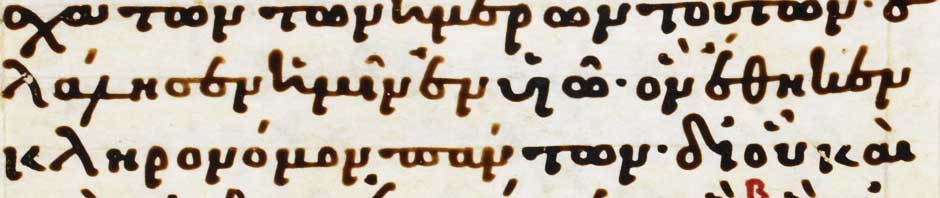
Ἥ τε θάλασσα ἀνέμου μεγάλου πνέοντος διεγείρετο. (John 6:18)
And the sea was being stirred up by a great wind blowing.
As the Wind Blew, the Sea Awoke
John 6:18 gives a compact but vivid description of a growing storm that sets the stage for Jesus walking on the sea. The Greek employs a genitive absolute, a passive imperfect verb, and the narrative particle τε to convey rising tension and atmospheric drama. The grammar mirrors the physical reality: the disciples’ world is becoming unstable.
1. Subject and Narrative Connector: ἥ τε θάλασσα
- ἥ – Nominative singular feminine definite article, referring to θάλασσα
- τε – Enclitic particle meaning “also” or “and indeed,” used here to tightly link this clause to what came before
- θάλασσα – “the sea,” the subject of the main verb διεγείρετο
This phrase introduces the main scene — “the sea also…” — contributing to the narrative escalation. The particle τε signals that this is a natural consequence or accompaniment to the wind blowing.
2. Genitive Absolute: ἀνέμου μεγάλου πνέοντος
This is a classic genitive absolute, a construction that sets a background circumstance outside the main grammatical flow:
- ἀνέμου – Genitive singular of ἄνεμος, “wind”
- μεγάλου – Genitive singular adjective, “great,” modifying ἀνέμου
- πνέοντος – Present active participle, genitive masculine singular of πνέω, “to blow”
This phrase translates:
“as a strong wind was blowing”
The present participle conveys ongoing force, creating a vivid image of sustained turbulence. The genitive absolute sets the causal or temporal backdrop for the sea’s agitation.
Main Verb: διεγείρετο
- διεγείρετο – Imperfect Passive Indicative, 3rd Person Singular of διαγείρω, “to be stirred up,” “to be aroused”
This imperfect passive verb describes an ongoing process in past time:
“the sea was being stirred up”
The passive voice suggests the sea is acted upon — by the wind — and the imperfect tense reflects the gradual build-up of the storm, not a sudden outburst.
Flow of Action and Atmosphere
The structure is simple but highly effective:
- Background condition (genitive absolute): A great wind was blowing
- Main clause: The sea also was being stirred up
The order of the Greek stresses the environmental instability — the wind and sea are conspiring to threaten the disciples, just before Christ appears walking on the water.
Grammar as Prelude to a Miracle
In John 6:18, John’s Greek sets the tension and danger without drama. The participial phrase and imperfect passive verb quietly elevate the scene to the edge of fear — the stage is ready for divine intervention.
The sea was not just choppy — it was being awakened. And soon, the One who rules the seas would arrive.