The history of Greek New Testament editions is not merely a list of printed books. It is the story of how scholars, printers, translators, churches, universities, and manuscript researchers worked across centuries to preserve, compare, publish, and study the Greek text of the New Testament. For beginners in Koine Greek, this subject may look intimidating at first because the names are Latin, the dates are many, and the editions often sound similar. Yet the story becomes much clearer when we understand one simple fact: every printed Greek New Testament edition stands somewhere between the handwritten manuscript tradition and the reader who wants to study the New Testament in its original language.
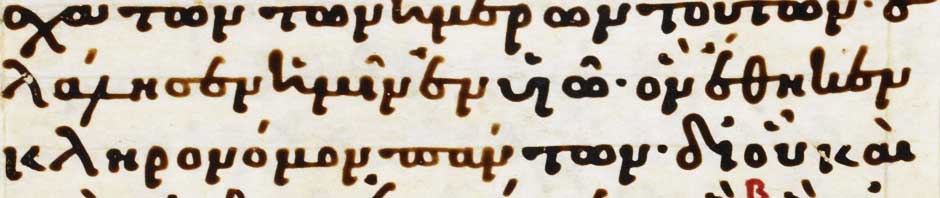
Before the age of printing, the Greek New Testament was copied by hand. Scribes produced manuscripts on papyrus, parchment, and later paper. Some manuscripts contained the whole New Testament, while others contained only the Gospels, the Pauline Epistles, Acts and the Catholic Epistles, Revelation, lectionary readings, or fragments of individual books. Because copying was done by hand, small differences entered the manuscript tradition. These differences are called textual variants. Most variants are minor, such as spelling differences, word order changes, or the presence or absence of small particles. A smaller number affect the wording of a verse more noticeably. The discipline that studies these differences is called textual criticism.
Textual criticism does not mean criticizing Scripture in a disrespectful sense. Rather, it means carefully comparing manuscript evidence to understand the history of the text and to determine, as far as possible, the earliest attainable form of the wording. Printed editions of the Greek New Testament are the fruit of this work. Some editions mainly reproduce the form of text that became dominant in the Byzantine manuscript tradition. Others attempt to reconstruct the earliest recoverable text by weighing evidence from papyri, uncials, minuscules, ancient translations, and quotations in early Christian writers.
For the student of Koine Greek, knowing the major Greek New Testament editions is useful for several reasons. First, it helps explain why different Greek texts sometimes have different readings. Second, it gives historical context for translations such as the King James Version, which was influenced by the printed Textus Receptus tradition. Third, it helps modern readers understand why editions such as Nestle-Aland, UBS, Tyndale House, and the Editio Critica Maior matter in academic study today. Finally, it reminds us that the Greek New Testament did not arrive to modern readers as an isolated book, but through a long history of copying, editing, printing, correcting, and studying.
Beginner’s Key Idea: A Greek New Testament edition is a printed or digital presentation of the Greek text, usually prepared by editors who compare manuscripts and make decisions about which readings should appear in the main text and which should be listed in the notes or apparatus.
Why Greek New Testament Editions Matter
When a beginner opens a Greek New Testament, it is easy to assume that the printed words simply represent “the Greek Bible.” However, every edition is the result of editorial decisions. The editors must decide which manuscripts to follow, how much weight to give to early manuscripts, how to treat Byzantine readings, whether to include spelling variations, how to punctuate the text, where to divide paragraphs, and how much evidence to provide in the critical apparatus.
A critical apparatus is the set of notes, usually printed at the bottom of the page, that records important textual variants. In a beginner’s Greek New Testament, this apparatus may be short and selective. In a major scholarly edition, it may be much fuller. The apparatus allows the reader to see where manuscripts differ. For example, one group of manuscripts may include a phrase while another omits it. One manuscript may use one verb form while another uses a synonym. One tradition may place words in a different order. The apparatus does not usually explain every detail for beginners, but it gives the evidence needed for scholarly study.
The development of Greek New Testament editions can be divided into broad periods. The first period is the early printed period, beginning with the Complutensian Polyglot and Erasmus. The second period is the Textus Receptus period, when the editions of Erasmus, Stephanus, Beza, and the Elzevirs became influential in Europe. The third period is the rise of modern textual criticism, when scholars such as Lachmann, Tischendorf, Tregelles, Westcott, and Hort challenged the dominance of the Textus Receptus. The fourth period is the modern critical period, represented by Nestle-Aland, UBS, the Tyndale House Greek New Testament, and the Editio Critica Maior.
These periods do not represent a simple movement from “bad” to “good.” Each period had its own tools, limitations, and strengths. Erasmus worked with the manuscripts available to him. Stephanus made advances in printing and apparatus. Beza influenced Reformation-era translation. Tischendorf brought major manuscript discoveries into scholarly discussion. Westcott and Hort proposed a powerful theory of textual history. Nestle created a compact comparative edition that became enormously influential. The modern editions benefit from far more manuscript evidence and more refined methods, but they stand on the work of earlier generations.
1. Complutensian Polyglot Bible (1514)
Editors: Cardinal Francisco Jiménez de Cisneros and team
Publication Year: Printed 1514; published 1520
Historical Setting: Early Spanish humanism and Renaissance biblical scholarship
Notes: The Complutensian Polyglot Bible was one of the great scholarly achievements of the early sixteenth century. It was produced under the patronage of Cardinal Francisco Jiménez de Cisneros at the University of Alcalá in Spain. The word “Complutensian” comes from Complutum, the Latin name associated with Alcalá. A polyglot Bible presents the biblical text in multiple languages, and this project included Hebrew, Greek, Latin, and other textual materials depending on the section.
The Greek New Testament portion was printed in 1514, which makes it the first printed Greek New Testament. However, it was not the first to be published and circulated. Because of delays connected with approval and publication, Erasmus’s 1516 edition reached the public first. This is why the Complutensian Polyglot is often described as the first printed Greek New Testament but not the first published Greek New Testament.
The importance of the Complutensian Polyglot lies not only in its date but also in its scholarly ambition. It represented a desire to return to the original languages of Scripture. During the Renaissance, many scholars believed that serious study required going back to the sources. For the Old Testament, that meant Hebrew. For the New Testament, that meant Greek. The Complutensian project expressed this ideal on a grand scale.
For beginners, the Complutensian Polyglot teaches an important lesson: printed Greek New Testaments did not arise merely from private curiosity. They were connected to universities, church leaders, humanist scholarship, and the renewed study of ancient languages. The Greek text was not printed as an isolated academic artifact. It was printed because scholars believed that Greek mattered for theology, translation, preaching, and interpretation.
2. Novum Instrumentum Omne (1516)
Editor: Desiderius Erasmus
Revised Editions: 1516, 1519, 1522, 1527, 1535
Historical Setting: Renaissance humanism and the early Reformation era
Notes: Erasmus’s Novum Instrumentum Omne, published in 1516, was the first Greek New Testament to be published and made available to readers. The title means “The Whole New Instrument,” though later editions used the more familiar title Novum Testamentum. Erasmus printed the Greek text alongside his own revised Latin translation. His aim was not simply to print Greek for specialists, but to encourage better understanding of the New Testament through careful comparison of Greek and Latin.
Erasmus worked quickly, and his first edition contained printing errors and weaknesses. He had access to only a small number of Greek manuscripts, and some were relatively late. In the book of Revelation, his manuscript lacked the final verses, so Erasmus famously supplied Greek by translating from Latin back into Greek. Later editors corrected some problems, but the first edition’s limitations became part of the history of the printed text.
Despite these weaknesses, Erasmus’s work was enormously influential. His editions became foundational for later printed Greek texts. The 1519 edition influenced Martin Luther’s German New Testament. The Erasmus tradition also became part of the stream that eventually came to be called the Textus Receptus. This does not mean that Erasmus invented the New Testament text, but his printed edition became a major reference point for later editors and translators.
For students, Erasmus is important because he shows the power of print. A manuscript can influence a local reader or monastery. A printed edition can influence Europe. Once Greek New Testaments could be printed in many copies, scholars could compare, debate, translate, and teach from a shared text. Erasmus helped make the Greek New Testament accessible in a new way, even though his edition was imperfect.
3. Novum Testamentum Graecum by Simon de Colines (1524–1525)
Editor: Simon de Colines
Publication Years: 1524–1525
Historical Setting: Early French printing and humanist scholarship
Notes: Simon de Colines, also known as Colinaeus, produced an early printed Greek New Testament that drew on the textual work already available through Erasmus and the Complutensian tradition. His edition did not become as influential as Erasmus, Stephanus, or Beza, but it belongs to the early stage of printed Greek New Testament history.
De Colines was an important printer in Paris. The early history of Greek New Testament editions is inseparable from the history of printing. Fonts, layout, accuracy, correction, and distribution all mattered. A Greek New Testament required more than an editor with manuscripts. It required printers capable of handling Greek type, proofreaders who could catch errors, and a reading public interested in Greek learning.
This edition reminds us that the printed Greek New Testament did not develop in a straight line through only one editor. Several printers and scholars participated in the process. Some editions became famous; others remained secondary. Yet even the secondary editions show how quickly Greek New Testament printing spread after Erasmus.
4. Novum Testamentum by Robert Estienne, or Stephanus (1546, 1549, 1550, 1551)
Editor: Robert Estienne, also known as Stephanus
Important Editions: 1546, 1549, 1550, 1551
Historical Setting: French Renaissance printing and Reformation-era scholarship
Notes: Robert Estienne, commonly known by the Latinized name Stephanus, was one of the most important figures in the history of the printed Greek New Testament. His editions refined and transmitted the developing printed text. The 1550 edition is especially famous and is often called the Editio Regia, or “Royal Edition.” It was beautifully printed and included a critical apparatus listing readings from selected manuscripts and earlier editions.
The 1550 Stephanus edition is significant because it shows a growing awareness of textual variation. Earlier printed editions presented a Greek text, but Stephanus also provided evidence for alternative readings. This apparatus was not as full or systematic as modern apparatuses, but it was an important step. It allowed readers to see that manuscripts did not always agree and that printed editors had to make choices.
The 1551 edition of Stephanus is famous for another reason: it introduced the verse numbering system that became standard in printed New Testaments. Chapter divisions existed earlier, but verse divisions as we know them became widely associated with Stephanus. This practical feature changed how readers cited, memorized, debated, and studied Scripture. Today, when students refer to John 3:16 or Romans 5:1, they are using a system shaped by this period of printing history.
Stephanus’s work strongly influenced later editions of the Textus Receptus. For beginners, he is important because he connects three things that are often separated: the Greek text, the apparatus, and the reference system. He was not only transmitting words; he was shaping how readers physically encountered the New Testament on the printed page.
5. Novum Testamentum by Theodore Beza (1565–1604)
Editor: Theodore Beza
Editions: 1565, 1567, 1582, 1588, 1589, 1598, 1604
Historical Setting: Reformed scholarship after Calvin
Notes: Theodore Beza was a major Reformed theologian and scholar. His Greek New Testament editions continued the printed tradition that had developed through Erasmus and Stephanus. Beza’s editions were influential in Protestant Europe and played an important role in the textual background of the King James Version.
Beza had access to important manuscripts, including the manuscript now known as Codex Bezae. However, his printed text generally remained within the established printed tradition rather than radically revising it according to manuscript evidence. This illustrates an important feature of the Textus Receptus period: once a printed text became widely accepted, it gained authority through use, repetition, and tradition.
Beza’s influence was not only textual but theological and ecclesiastical. His editions circulated among readers who were deeply involved in Reformation debates. The Greek New Testament was not being studied in a neutral academic vacuum. It mattered for doctrine, preaching, translation, and confessional identity. The printed Greek text became part of the intellectual world of Protestant scholarship.
For beginners, Beza helps explain why the Textus Receptus became so influential. It was not because one single editor produced a perfect edition. Rather, a chain of editions became embedded in the study habits, translation work, and theological culture of early modern Europe.
6. Elzevir Editions and the Phrase “Textus Receptus” (1624, 1633)
Editors/Publishers: Bonaventure and Abraham Elzevir
Important Editions: 1624, 1633
Historical Setting: Dutch printing and the consolidation of the received printed text
Notes: The Elzevir editions are famous because the 1633 edition included a promotional phrase in the preface that gave rise to the expression Textus Receptus, meaning “received text.” The phrase suggested that the reader had the text now received by all. Over time, “Textus Receptus” became a label for the stream of printed Greek New Testament editions descending from Erasmus, Stephanus, Beza, and the Elzevirs.
It is important to understand that “Textus Receptus” is not the name of one single ancient manuscript. It is a printed textual tradition. It reflects the manuscripts and editorial choices available to early modern scholars, especially in the Byzantine tradition, but it is not identical to any one manuscript. Different Textus Receptus editions have small differences among themselves.
The Textus Receptus became especially important because it stood behind major Reformation-era translations. The King James Version was translated in a textual environment shaped by this tradition. Therefore, discussions of the Textus Receptus are often connected to discussions of English Bible translation, especially among readers who value the KJV tradition.
For beginners, the key point is this: the Textus Receptus is historically important, but it should not be confused with the entire Greek manuscript tradition. It is a printed form of the text that became widely received in early modern Europe. Modern critical editions use a much broader range of manuscript evidence, including papyri and early uncial manuscripts unknown or underused by the early printed editors.
7. Brian Walton’s Polyglot Bible (1657)
Editor: Brian Walton
Publication Year: 1657
Notes: Walton’s London Polyglot was one of the most ambitious biblical publishing projects of the seventeenth century. It presented multiple biblical texts and versions in parallel columns, including Greek, Hebrew, Aramaic, Syriac, Arabic, Ethiopic, and Latin. Although not a new critical Greek New Testament edition, it significantly advanced comparative textual study and laid foundations for later textual criticism.
From the Textus Receptus to Modern Textual Criticism
For several centuries, the Textus Receptus functioned as the standard printed Greek New Testament in many Protestant contexts. However, as more manuscripts were discovered, catalogued, and compared, scholars began to question whether the received printed text always represented the earliest recoverable wording. This did not happen overnight. It required the accumulation of manuscript evidence, the development of better methods, and the courage to challenge a familiar printed tradition.
Modern textual criticism developed as scholars realized that older manuscripts often differed from the later printed text. They also observed that manuscripts could be grouped into textual families or text-types. Although older theories of text-types have been refined and sometimes challenged, the basic insight remains important: manuscripts have histories, and their readings must be evaluated in relation to age, geographical distribution, scribal habits, and internal coherence.
The nineteenth century became a turning point. Scholars such as Scholz, Lachmann, Tischendorf, Tregelles, and later Westcott and Hort moved the discussion away from simply reprinting the received text. They placed greater emphasis on early manuscripts and on reconstructing the history of textual transmission.
8. John Mill’s Novum Testamentum Graecum (1707)
Editor: John Mill
Publication Year: 1707
Notes: John Mill’s edition was a landmark in New Testament textual criticism because it gathered a very large number of textual variants from manuscripts, earlier editions, ancient versions, and patristic citations. Although Mill did not abandon the received printed text as his base, his extensive apparatus made readers more aware of the complexity and richness of the Greek manuscript tradition. His work helped move New Testament study toward a more evidence-based comparison of witnesses.
9. Johann Jakob Wettstein’s Novum Testamentum Graecum (1751–1752)
Editor: Johann Jakob Wettstein
Publication Years: 1751–1752
Notes: Wettstein produced one of the most important eighteenth-century Greek New Testament editions. His edition retained the received text as its printed base, but his apparatus was remarkably rich, drawing from Greek manuscripts, versions, patristic citations, and parallels from classical, Jewish, and early Christian literature. Wettstein is also remembered for his influence on manuscript notation, especially the use of letter symbols for major manuscripts.
10. Johann Jakob Griesbach’s Novum Testamentum Graece (1774–1775; later editions)
Editor: Johann Jakob Griesbach
Important Editions: 1774–1775, 1796–1806
Notes: Griesbach was one of the most important figures in the development of modern New Testament textual criticism. He advanced the classification of manuscripts into major textual groupings, often described as Western, Alexandrian, and Constantinopolitan or Byzantine. Griesbach did not merely collect variants; he worked toward a more systematic method for evaluating them. His principles helped prepare the way for nineteenth-century critical editors such as Lachmann, Tischendorf, Tregelles, and Westcott-Hort.
11. Novum Testamentum Graece by Johann Martin Augustin Scholz (1830–1836)
Editor: Johann Martin Augustin Scholz
Publication Years: 1830–1836
Historical Setting: Early nineteenth-century manuscript collation
Notes: Johann Martin Augustin Scholz produced an edition that attempted to incorporate a wide range of manuscript evidence. His work belongs to the period when scholars were increasingly interested in cataloguing manuscripts and comparing textual witnesses. Although later scholarship criticized some aspects of his method and accuracy, Scholz contributed to the broadening of textual evidence.
Scholz’s significance lies in the movement from a narrow printed tradition toward a wider manuscript base. The more manuscripts scholars compared, the clearer it became that the history of the New Testament text was complex. Manuscripts from different regions and periods preserved different patterns of readings. This required more careful classification and evaluation.
For beginners, Scholz may not be as famous as Erasmus, Tischendorf, or Westcott and Hort, but he represents an important transitional stage. The printed Greek New Testament was becoming a scholarly reconstruction informed by manuscript research rather than a simple continuation of the received printed text.
12. Novum Testamentum Graece by Karl Lachmann (1831)
Editor: Karl Lachmann
Publication Year: 1831
Historical Setting: The rejection of automatic Textus Receptus priority
Notes: Karl Lachmann’s 1831 edition was revolutionary because it openly rejected the Textus Receptus as the automatic base text. Lachmann aimed to reconstruct the text according to early evidence rather than simply reproduce the printed tradition. His edition was not perfect, and later scholars had access to more evidence, but the principle was decisive.
Lachmann treated the New Testament like other ancient texts in one important respect: he believed the editor should examine the manuscript evidence and not simply accept the latest traditional printed form. This approach helped shift the discipline toward critical reconstruction. He was not trying to create novelty for its own sake. He was trying to recover an earlier form of the text by using older witnesses.
For beginners, Lachmann is important because he marks a change in attitude. Before him, many editions corrected or adjusted the Textus Receptus. Lachmann challenged the assumption that the Textus Receptus should control the discussion. This opened the way for later critical editions.
13. Novum Testamentum Graece by Constantin von Tischendorf (1841–1872)
Editor: Constantin von Tischendorf
Editions: Eight major editions from 1841 to 1872
Historical Setting: Manuscript discovery and nineteenth-century textual scholarship
Notes: Constantin von Tischendorf was one of the most energetic manuscript scholars in the history of New Testament textual criticism. He travelled widely, examined manuscripts, and published multiple editions of the Greek New Testament. His eighth edition is especially important because it incorporated evidence from Codex Sinaiticus, one of the most significant biblical manuscripts known.
Tischendorf’s work highlights the importance of manuscript discovery. A printed edition can only use evidence known to the editor. When major manuscripts become available, the discussion changes. Codex Sinaiticus, along with Codex Vaticanus, became central to modern discussions of the early text of the New Testament. These manuscripts often supported readings different from the Textus Receptus.
Tischendorf’s editions were detailed and influential. He gathered evidence on a scale that earlier editors could not match. Although later scholars revised many of his conclusions, his contribution remains monumental. He helped make the Greek New Testament a field of rigorous manuscript-based research.
For beginners, Tischendorf teaches that textual criticism is not only a matter of theories. It is also a matter of physical manuscripts, libraries, travel, transcription, and patient comparison. The Greek text on a modern page is connected to centuries-old manuscripts preserved in monasteries, libraries, and collections.
14. Novum Testamentum Graece by Augustus Hahn (1841)
Editor: Augustus Hahn
Publication Year: 1841
Historical Setting: German critical scholarship
Notes: Augustus Hahn produced a Greek New Testament edition that was influential in German scholarly circles. His work included a critical apparatus and participated in the growing nineteenth-century effort to provide students and scholars with a text informed by manuscript evidence.
Hahn’s edition may not be as famous among general readers as those of Tischendorf or Westcott and Hort, but it belongs to the same scholarly movement. Greek New Testament editions were becoming tools for academic study. They were not merely ecclesiastical texts for reading and translation. They were also research instruments.
For the beginner, Hahn’s place in the list shows that nineteenth-century textual criticism was not a one-person revolution. Many scholars contributed to the shift from the received printed text to manuscript-based critical editions. Some became famous; others influenced particular academic settings.
15. Novum Testamentum Graece by Samuel Prideaux Tregelles (1860)
Editor: Samuel Prideaux Tregelles
Publication Year: 1860 and following parts
Historical Setting: Careful collation and ancient manuscript priority
Notes: Samuel Prideaux Tregelles was deeply committed to grounding the Greek New Testament text in ancient evidence. He valued careful collation and sought to avoid editorial decisions based merely on tradition or convenience. His work was marked by patience, discipline, and a strong concern for objectivity.
Tregelles believed that ancient manuscripts deserved serious weight. Like other nineteenth-century critics, he challenged the dominance of the Textus Receptus. His edition contributed to the scholarly environment that prepared the way for Westcott and Hort.
For beginners, Tregelles is important because he represents the ethical side of textual criticism. The editor’s task is not to defend a favorite tradition at all costs, nor to produce novelty for attention. The task is to examine the evidence carefully and honestly. Tregelles’s work reminds students that textual criticism requires intellectual humility.
16. The New Testament in the Original Greek by Westcott and Hort (1881)
Editors: Brooke Foss Westcott and Fenton John Anthony Hort
Publication Year: 1881
Historical Setting: A major turning point in modern critical editions
Notes: Westcott and Hort’s The New Testament in the Original Greek became one of the most influential Greek New Testament editions ever published. Their work placed great weight on early manuscripts, especially Codex Vaticanus and Codex Sinaiticus. They argued that the Textus Receptus often reflected a later form of the text and that earlier witnesses should be given priority when the evidence supported them.
Their theory of textual history was highly influential. They distinguished between different forms of the text and gave particular value to what they called the Neutral text, especially associated with Codex Vaticanus. Some aspects of their terminology and theory have been revised by later scholars, but their edition decisively shaped modern New Testament textual criticism.
Westcott and Hort also influenced English Bible translation. The Revised Version of 1881 reflected the move away from the Textus Receptus toward a critical Greek text. This created controversy because many readers were accustomed to the wording of the King James Version. The debate was not merely academic. It affected churches, readers, sermons, and public perception of the Bible.
For beginners, Westcott and Hort are important because they explain why modern Greek New Testaments often differ from the Textus Receptus. They did not simply remove words arbitrarily. They followed a theory of manuscript evidence and textual history. Whether one agrees with all their conclusions or not, their work must be understood as a serious scholarly attempt to recover the earliest attainable text.
17. The English Revised Version Greek Text (1881)
Editors: Revision Committee
Publication Year: 1881
Notes: Although not issued as an independent critical edition, the Greek text underlying the Revised Version reflected many of the critical principles championed by Westcott and Hort and marked a significant departure from the Textus Receptus tradition in English Bible translation.
18. The New Testament in Greek According to the Text Followed in the Authorised Version (1881)
Editors: F.H.A. Scrivener
Publication Year: 1881
Notes: Scrivener reconstructed the Greek text underlying the King James Version. This edition remains important for studies of the Textus Receptus and the textual basis of the Authorized Version.
19. Novum Testamentum Graece by Hermann von Soden (1894–1900)
Editor: Hermann von Soden
Publication Period: 1894–1900 and related work
Historical Setting: Large-scale classification of manuscripts
Notes: Hermann von Soden attempted to classify New Testament manuscripts into textual groups using a complex system. His work was ambitious, detailed, and difficult. He introduced new symbols and categories that many later readers found challenging. Although his system did not become the standard way of presenting evidence, his effort reflected a major scholarly concern: how should thousands of manuscripts be organized and evaluated?
Von Soden’s work reminds us that textual criticism is not only about individual variants. It is also about patterns. If manuscripts share many readings, they may be historically related. If a group of manuscripts consistently agrees against another group, the editor must ask why. Classification helps scholars understand transmission history.
For beginners, von Soden may seem complicated, but his importance lies in the question he tried to answer. The New Testament manuscript tradition is large. Without classification, the evidence becomes overwhelming. Even when later scholars reject or revise a classification system, they continue to face the same basic problem: how do we make sense of the manuscript evidence as a historical tradition?
20. Novum Testamentum Graece by Eberhard Nestle (1898)
Editor: Eberhard Nestle
Publication Year: 1898
Historical Setting: The beginning of the Nestle tradition
Notes: Eberhard Nestle’s 1898 edition was a major step toward the modern compact critical Greek New Testament. Instead of producing an entirely independent reconstruction, Nestle compared major critical editions, especially those of Tischendorf, Westcott and Hort, and Weymouth. Where these editions differed, he used a method of comparison to determine the printed text.
This approach made Nestle’s edition practical and useful. It offered students and scholars a compact text that reflected the major critical work of the nineteenth century. Over time, the Nestle tradition developed into the Nestle-Aland edition, which became the standard academic Greek New Testament.
Nestle’s genius was partly editorial and partly practical. A massive edition with exhaustive evidence is valuable for specialists, but students need a reliable, portable text. Nestle helped create that kind of edition. His work became a bridge between major scholarly research and everyday academic use.
For beginners, Nestle matters because many Greek students today use an edition descended from his work. When someone refers to “NA28,” the “N” in that abbreviation stands in the tradition of Nestle. The modern Nestle-Aland edition has changed greatly since 1898, but the historical line begins here.
21. Novum Testamentum Graece by Bernhard Weiss (1899–1905)
Editor: Bernhard Weiss
Publication Period: 1899–1905
Historical Setting: Alternative critical text within German scholarship
Notes: Bernhard Weiss produced a Greek New Testament edition that reflected strong engagement with Alexandrian evidence and German critical scholarship. His edition did not replace the Nestle tradition, but it contributed to the broader scholarly conversation at the turn of the twentieth century.
Weiss’s work shows that modern critical editions did not emerge from one uniform school. Scholars could agree that the Textus Receptus should not simply be followed, yet disagree about individual readings, manuscript weighting, and method. This diversity of judgment is normal in textual criticism because the evidence must be interpreted.
For beginners, Weiss helps correct a common misunderstanding. Modern critical texts are not produced by one editor making private decisions without debate. They arise from a long conversation among scholars, editions, manuscripts, methods, and competing judgments.
22. Novum Testamentum Graece: Nestle-Aland Tradition (1904–2012)
Editors: Eberhard Nestle, Erwin Nestle, Kurt Aland, Barbara Aland, and others
Important Modern Edition: NA28, published in 2012
Historical Setting: The standard compact critical edition for academic study
Notes: The Nestle-Aland edition is the most widely recognized academic Greek New Testament today. It developed from Eberhard Nestle’s 1898 work and was later revised by Erwin Nestle, Kurt Aland, Barbara Aland, and the Institute for New Testament Textual Research. The edition combines a critically established Greek text with an apparatus that records important variants.
The Nestle-Aland edition is not designed to list every manuscript reading in existence. It is a compact scholarly edition. Its apparatus is selective but extremely useful. It gives students, pastors, translators, and scholars access to the most important variants without overwhelming the page with the full evidence found in larger projects.
NA28, published in 2012, is the current standard edition in many academic settings. One major feature of NA28 is its relationship to the Editio Critica Maior, especially in the Catholic Epistles. The main text of NA28 differs from NA27 in a limited number of places, especially where the ECM work led to changes.
For beginners, the Nestle-Aland edition is often the Greek New Testament encountered in seminary, university, or serious self-study. Its apparatus may seem difficult at first, but learning to read even the basic symbols opens the door to deeper textual awareness. A student does not need to master every detail immediately. It is enough to understand that the apparatus shows where important manuscript differences exist.
23. The Greek New Testament (UBS) (1966–Present)
Editors: Kurt Aland, Matthew Black, Carlo M. Martini, Bruce M. Metzger, Allen Wikgren, and subsequent editorial committees
First Edition: 1966
Current Edition: UBS5 (2014)
Notes: Published by the United Bible Societies, the UBS Greek New Testament was designed primarily for Bible translators and students. While its text is very similar to the Nestle-Aland edition, its apparatus focuses on variants that significantly affect translation and interpretation rather than providing exhaustive manuscript evidence. The accompanying textual commentary, particularly Bruce Metzger’s work explaining editorial decisions, has made the UBS edition one of the most widely used tools in biblical scholarship and translation work throughout the world.
24. The Greek New Testament: Majority Text Edition (1982)
Editors: Zane C. Hodges and Arthur L. Farstad
Publication Year: 1982
Historical Setting: Renewed interest in the Byzantine majority tradition
Notes: The Majority Text edition by Zane Hodges and Arthur Farstad represents a different approach from the standard modern critical text. Instead of giving priority mainly to the earliest manuscripts, the Majority Text approach gives significant weight to the reading found in the majority of Greek manuscripts, which are mostly Byzantine in character.
The argument behind the Majority Text position is that the dominant manuscript tradition should not be dismissed simply because many of its witnesses are later. Advocates argue that the widespread Byzantine tradition may preserve ancient readings and should be taken seriously as a testimony to the text used and copied through much of the Greek-speaking church.
Critics respond that numerical majority alone does not necessarily prove originality. If many later manuscripts descend from a common earlier form, they may multiply a secondary reading. Therefore, modern critical editors usually weigh manuscripts by age, quality, geographical distribution, and internal considerations rather than by simple majority count.
For beginners, the Majority Text edition is useful because it shows that textual criticism includes different philosophies. Not all editors answer the same question in the same way. Some ask, “What reading is earliest according to the strongest evidence?” Others ask, “What reading is represented by the majority of the manuscript tradition?” Understanding this difference helps students avoid oversimplified debates.
25. The New Testament in the Original Greek: Byzantine Textform (2005)
Editors: Maurice A. Robinson and William G. Pierpont
Publication Year: 2005 (revised editions followed)
Notes: This edition presents the Greek New Testament according to the Byzantine Textform, based on the principle that the Byzantine textual tradition preserves the most reliable form of the New Testament text. Unlike the Majority Text edition of Hodges and Farstad, which determines readings by numerical majority among manuscripts, Robinson and Pierpont advocate a Byzantine-priority methodology that evaluates the transmissional history and stability of the Byzantine tradition. The edition has become one of the standard reference texts for scholars and students interested in the Byzantine text-type and serves as an important alternative to both the Textus Receptus and the modern critical text. It is widely cited in contemporary discussions of New Testament textual criticism and the history of the Greek text.
26. The SBL Greek New Testament (SBLGNT) (2010)
Editor: Michael W. Holmes
Publication Year: 2010
Publisher: Society of Biblical Literature (SBL)
Notes: The SBL Greek New Testament (SBLGNT) was edited by Michael W. Holmes and published by the Society of Biblical Literature. Rather than producing a completely new critical apparatus, Holmes compared several major modern editions—including the Nestle-Aland text, the United Bible Societies text, the Robinson-Pierpont Byzantine Textform, and the Westcott-Hort edition—to establish a carefully reasoned Greek text. One of the edition’s most significant contributions is its open-access availability, allowing students, scholars, pastors, and software developers to use the text freely. The SBLGNT has become a popular resource in academic institutions, Bible software platforms, and online study tools due to its accessibility and scholarly quality.
27. The Greek New Testament Produced at Tyndale House (2017)
Editors: Dirk Jongkind and Peter J. Williams, with a scholarly team
Publication Year: 2017
Historical Setting: A recent edition emphasizing scribal habits, early evidence, and philological care
Notes: The Tyndale House Greek New Testament, often abbreviated THGNT, was produced by scholars connected with Tyndale House, Cambridge. It presents a fresh edition of the Greek New Testament based on careful examination of the manuscript tradition. Its editors paid close attention not only to textual variants but also to spelling, paragraphing, scribal habits, and the physical realities of manuscript transmission.
The THGNT is especially helpful for students because it reminds us that textual editing is not only about choosing between large variant units. Details such as spelling, word division, punctuation, and paragraphing affect how readers encounter the text. Ancient manuscripts did not look like modern printed Bibles. Editors must decide how to present the text in a readable modern form while respecting ancient evidence.
The THGNT differs from Nestle-Aland in some readings and presentation choices. It does not replace NA28 in all academic contexts, but it provides a valuable alternative. Students who compare THGNT and NA28 can learn how different editorial philosophies produce slightly different printed texts.
For beginners, the Tyndale House edition is a good reminder that Greek New Testament study is still alive. The field did not end with Westcott and Hort or even with Nestle-Aland. Scholars continue to reexamine manuscripts, scribal habits, and editorial assumptions.
28. Editio Critica Maior (ECM) (1997–Present)
Editors: Institute for New Testament Textual Research, Münster
Publication Period: 1997–present
Historical Setting: The most comprehensive modern critical edition project
Notes: The Editio Critica Maior, commonly abbreviated ECM, is the most comprehensive critical edition project for the Greek New Testament. It is not a small handheld edition for ordinary reading. It is a major scholarly project designed to present extensive manuscript evidence, ancient versions, and patristic citations. Its goal is to reconstruct the earliest attainable text of each New Testament book with a much fuller apparatus than compact editions can provide.
The ECM is important because it stands behind revisions in the Nestle-Aland tradition. The work done for the ECM has influenced the text of NA28, especially in the Catholic Epistles. This means that the compact edition many students use is connected to a much larger research project.
The ECM also uses advanced methods for understanding textual coherence. Rather than treating variants as isolated problems, the editors examine how witnesses relate to one another across many readings. This allows for a more refined understanding of textual transmission.
For beginners, the ECM may be too advanced for daily use, but it is important to know what it represents. It is like the deep research foundation beneath the smaller editions used in classrooms. A student may not consult the ECM often, but the ECM helps shape the critical text that appears in modern scholarly editions.
29. The Greek New Testament Collation Project
Website: GreekNewTestament.Net
Project Type: Digital collation and transcription project
Notes: The Greek New Testament Collation Project of GreekNewTestament.Net aims to collate and transcribe the extant Greek New Testament manuscript tradition. Unlike a traditional printed critical edition, the project is designed for digital presentation, allowing manuscript readings and early Christian quotations to be compared in parallel. Its stated goal is to support the recovery of the earliest attainable text of the New Testament through broad manuscript comparison.
30. The Majority Text Project
Website: GreekNewTestament.Org
Project Type: Ongoing Byzantine/Majority Text project
Notes: The Majority Text project of GreekNewTestament.Org presents the Greek New Testament according to the majority manuscript tradition. The project emphasizes the ongoing collation and review of Greek New Testament manuscripts, with updates and revisions made as additional data and insights become available. It is especially useful for readers interested in the Byzantine textual tradition and the relationship between the Majority Text, the Textus Receptus, and modern critical editions.
How to Understand the Main Families of Editions
After seeing so many editions, beginners may feel overwhelmed. A helpful way to understand them is to group them into broad families. The first family is the early printed tradition, including the Complutensian Polyglot, Erasmus, de Colines, Stephanus, Beza, and the Elzevirs. These editions belong to the age when the Greek New Testament first entered print. They were based on limited manuscript evidence compared with what is available today, but they had enormous historical influence.
The second family is the Textus Receptus tradition. This overlaps with the early printed tradition but focuses especially on the form of the text that became widely received in Protestant Europe. The Textus Receptus is important for understanding the textual basis of many Reformation-era translations.
The third family is the nineteenth-century critical tradition. This includes Lachmann, Tischendorf, Tregelles, Westcott and Hort, and others. These scholars challenged the dominance of the Textus Receptus and emphasized earlier manuscript evidence.
The fourth family is the modern critical tradition. This includes Nestle-Aland, UBS, THGNT, and the ECM. These editions benefit from a much larger manuscript base, refined methods, and international scholarly collaboration.
The fifth category is the Majority Text tradition. This approach is not identical to the Textus Receptus, though they often agree in many places because both are related to the Byzantine tradition. The Majority Text seeks to represent the reading found in the majority of Greek manuscripts.
Comparison Table of Major Greek New Testament Editions
| Edition | Date | Main Importance | Beginner’s Memory Hook |
|---|---|---|---|
| Complutensian Polyglot | 1514 / 1520 | First printed Greek New Testament | Printed first, published later |
| Erasmus | 1516 | First published Greek New Testament | The edition that reached Europe first |
| Stephanus | 1550 / 1551 | Critical apparatus and verse numbering | Helped shape how we cite verses |
| Beza | 1565–1604 | Influential for Reformation translations | Important background to the KJV |
| Elzevir | 1624 / 1633 | Source of the phrase Textus Receptus | The “received text” label |
| Lachmann | 1831 | Rejected automatic TR priority | A turning point toward critical method |
| Tischendorf | 1841–1872 | Used major manuscript discoveries | Associated with Codex Sinaiticus |
| Westcott and Hort | 1881 | Major modern critical edition | Vaticanus and Sinaiticus emphasized |
| Nestle-Aland | 1898–2012 | Standard compact critical edition | The common academic Greek NT |
| THGNT | 2017 | Recent philological edition | Fresh edition from Tyndale House |
| ECM | 1997–present | Most comprehensive critical project | The deep research edition |
What Beginners Should Not Misunderstand
First, textual variants do not mean the New Testament text is hopelessly uncertain. The large number of variants exists partly because there are many manuscripts. Most variants are minor. The existence of variants is not a surprise; it is exactly what we expect from a large handwritten tradition.
Second, “oldest manuscript” does not automatically mean “original reading” in every case. An early manuscript can preserve a secondary reading, and a later manuscript can preserve an older reading. However, early evidence is still very important because it brings us closer to the earlier stages of transmission.
Third, “majority reading” does not automatically mean “original reading.” A reading may become numerous because it was copied often in a later tradition. At the same time, majority readings should not be dismissed carelessly. They are part of the manuscript history and must be examined seriously.
Fourth, the Textus Receptus and the Majority Text are not exactly the same thing. They often agree, but the Textus Receptus is a printed tradition, while the Majority Text is an editorial attempt to represent the majority of Greek manuscripts.
Fifth, modern critical editions are not designed to destroy faith. They are designed to present the Greek New Testament with careful attention to manuscript evidence. A student may prefer one edition over another, but the discussion should be informed, historical, and fair.
Which Edition Should a Beginner Use?
A beginner should usually start with a readable modern Greek New Testament designed for students. The Nestle-Aland edition is widely used in academic settings, but its apparatus can be challenging at first. The UBS Greek New Testament has the same basic critical text in many modern editions but presents a more translation-focused apparatus. The Tyndale House Greek New Testament is also attractive for readers who want a fresh, clean presentation of the text.
If a beginner is studying the King James Version tradition, the Textus Receptus may be useful for comparison. If a student is interested in Byzantine readings, a Majority Text edition may be helpful. However, for general academic study, NA28 and UBS editions remain central.
The best approach is not to turn edition choice into a battle before learning Greek. A beginner should first learn the alphabet, pronunciation, noun cases, verb forms, articles, prepositions, participles, and sentence structure. Once the student can read simple Greek clauses, textual differences become more meaningful. Without Greek knowledge, edition debates often become abstract and emotional.
A Simple Reading Path for Students
Stage 1: Learn the Greek Text
Use one main edition consistently. Focus on reading, vocabulary, grammar, and syntax. Do not become distracted by every variant too early.
Stage 2: Notice the Apparatus
Begin observing footnotes and variant readings. Learn the basic symbols slowly. Ask what kind of variation is being shown.
Stage 3: Compare Editions
Compare NA28, THGNT, Textus Receptus, and Majority Text readings in selected passages. Focus on actual examples rather than slogans.
Stage 4: Study Method
Learn external evidence, internal evidence, scribal habits, transcriptional probability, and intrinsic probability.
Key Terms for Beginners
Manuscript: A handwritten copy of part or all of the New Testament.
Papyrus: An early writing material made from the papyrus plant. Some of the earliest New Testament witnesses are papyri.
Uncial: A manuscript written in large capital-style Greek letters. Codex Sinaiticus and Codex Vaticanus are famous uncial manuscripts.
Minuscule: A manuscript written in a later, smaller, cursive-style Greek script.
Lectionary: A manuscript arranged for public reading in worship rather than in the normal order of biblical books.
Textual Variant: A difference in wording among manuscripts.
Critical Apparatus: Notes in a printed edition showing important textual variants and manuscript support.
Textus Receptus: The early modern printed Greek New Testament tradition associated with Erasmus, Stephanus, Beza, and the Elzevirs.
Majority Text: An edition or approach that gives special attention to readings found in the majority of Greek manuscripts, usually Byzantine.
Critical Text: A Greek text established through comparison and evaluation of manuscript evidence.
ECM: The Editio Critica Maior, a major comprehensive critical edition project.
The Story in One Paragraph
The Greek New Testament moved from handwritten manuscripts to printed editions in the early sixteenth century. The Complutensian Polyglot was printed first, but Erasmus’s 1516 edition was published first and became deeply influential. Stephanus, Beza, and the Elzevirs developed the printed tradition later called the Textus Receptus. In the nineteenth century, scholars such as Lachmann, Tischendorf, Tregelles, and Westcott and Hort challenged the dominance of the received printed text by appealing to earlier manuscript evidence. Eberhard Nestle created a compact edition that eventually developed into the Nestle-Aland tradition. Modern editions such as NA28, THGNT, and the ECM continue the work of comparing manuscripts and presenting the Greek New Testament as carefully as possible.
Why This History Strengthens Greek Study
Learning Koine Greek is not only learning vocabulary and grammar. It is entering a long conversation. Every accent mark, paragraph division, apparatus note, and printed reading has a history. When a beginner learns to read λόγος, χάρις, πίστις, or Ἰησοῦς Χριστός in Greek, that student is reading words preserved through centuries of copying and study.
This history should create patience. No beginner needs to master textual criticism immediately. However, every beginner can appreciate that the printed Greek New Testament is a carefully prepared scholarly tool. It is not magic, and it is not random. It is the result of thousands of manuscripts, generations of editors, and centuries of careful work.
The best students learn to avoid two extremes. One extreme treats the printed edition as if it fell from heaven with no history. The other extreme treats textual variation as if it destroys confidence. A wiser approach recognizes both the reality of textual variation and the strength of the manuscript tradition. The Greek New Testament is historically rich, deeply studied, and remarkably well-attested.
Practical Advice for Word-by-Word Greek Readers
If you are studying the Greek New Testament as a beginner, choose one primary edition and stay with it long enough to become comfortable. Read slowly. Mark repeated words. Observe articles. Watch case endings. Notice conjunctions. Learn how Greek builds meaning through grammar. Do not begin by arguing about editions before you can read the sentences.
After you become more comfortable, compare editions in selected passages. Ask simple questions. Is a word present in one edition but absent in another? Is the difference a spelling difference or a meaningful difference? Does the apparatus list early manuscripts? Does the variant affect translation? Does it affect doctrine, or is it mainly stylistic? These questions will train you to think carefully.
Textual criticism is best learned with real examples. Instead of memorizing slogans about Erasmus, Westcott and Hort, or NA28, open the Greek text and look at actual readings. The history of editions becomes clearer when connected to real verses.
The Value of Older Editions Today
Older editions remain valuable even when modern students use newer critical texts. Erasmus helps us understand the Renaissance and Reformation. Stephanus helps us understand verse numbering and early apparatus work. Beza helps us understand Reformed scholarship and the background of the King James Version. The Elzevirs explain the label Textus Receptus. Tischendorf reminds us of manuscript discovery. Westcott and Hort explain a major shift in textual theory. Nestle shows the value of a compact scholarly edition.
Therefore, older editions should not be mocked simply because they had fewer resources. They should be studied historically. Each edition belongs to its time. Each editor worked with particular manuscripts, tools, assumptions, and goals. Modern students benefit from their labors even when modern editions revise their conclusions.
The Value of Modern Editions Today
Modern editions are valuable because they use far more evidence than early printed editions could access. The discovery and study of papyri, the improved cataloguing of manuscripts, digital imaging, international collaboration, and refined methods have transformed the field. A modern critical edition is not merely a preference. It is the result of sustained scholarly work across many generations.
NA28 is especially useful as a compact academic standard. UBS editions are useful for translators. THGNT is useful as a fresh philological edition. The ECM is useful for advanced research. Majority Text editions are useful for studying the Byzantine tradition. Textus Receptus editions are useful for historical and translation comparison.
No single edition answers every need. The right edition depends on the purpose. A preacher, translator, textual critic, beginner, historian, and KJV-background reader may all use different editions for different reasons.
A Balanced Way to Speak About Greek New Testament Editions
A balanced student can say: the Textus Receptus is historically important, especially for Reformation-era translations. The Majority Text represents a serious interest in the Byzantine manuscript tradition. The Nestle-Aland edition is the standard compact critical text in much academic study. The Tyndale House edition offers a recent and carefully produced alternative. The ECM represents the most comprehensive scholarly project for the Greek New Testament text.
This kind of balanced language helps avoid unnecessary conflict. Greek New Testament editions should be discussed with accuracy rather than slogans. The goal is not to win arguments by naming an edition. The goal is to understand the Greek text more faithfully and historically.
From Printed Page to Living Study
The history of Greek New Testament editions is a history of access. The Complutensian scholars wanted Scripture studied in its original languages. Erasmus brought the Greek New Testament into public print. Stephanus improved the printed form and gave readers verse divisions. Beza carried the text into Reformation scholarship. The Elzevirs helped fix the language of the “received text.” Lachmann, Tischendorf, Tregelles, Westcott, and Hort pushed readers back to early manuscript evidence. Nestle and Aland gave students a compact critical tool. The Tyndale House editors and the ECM continue the work in the present.
For the beginner, this should be encouraging. When you open a Greek New Testament, you are not merely opening a textbook. You are opening a window into a long history of preservation, study, debate, and devotion to the words of the New Testament. Learning Greek allows you to enter that history more deeply, one word, one verse, and one edition at a time.