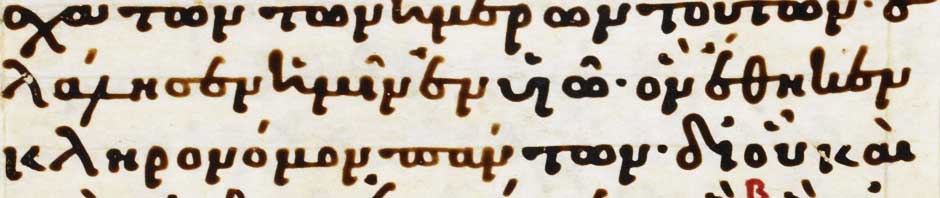
KATA MAΤΘAION 27:25
Καὶ ἀποκριθεὶς πᾶς ὁ λαὸς εἶπεν· Τὸ αἷμα αὐτοῦ ἐφ᾽ ἡμᾶς καὶ ἐπὶ τὰ τέκνα ἡμῶν
Transliteration
kai apokritheis pas ho laos eipen to haima autou eph’ hēmas kai epi ta tekna hēmōn
Literal Translation
And answering, all the people said, “His blood upon us and upon our children.”
Grammar Focus: The Participial Opening
The verse begins with καὶ ἀποκριθεὶς, which means “and answering.” The word ἀποκριθεὶς is a participle. A participle is a verbal form that often gives background action before the main verb.
ἀποκριθεὶς … εἶπεν = “answering … he/it said”
In English, we often smooth this into: “And all the people answered and said.” Greek can use a participle first, then the main verb after it.
The main verb is εἶπεν, “said.” Everything after that is the spoken statement.
Vocabulary Builder: Words Inside the Statement
| Greek Word | Transliteration | Meaning | Simple Usage Insight |
|---|---|---|---|
| ἀποκριθεὶς | apokritheis | answering | A participle that introduces the response. |
| πᾶς | pas | all, every | Here it describes the whole group as speaking. |
| λαὸς | laos | people | A collective noun, referring to a gathered people. |
| αἷμα | haima | blood | Here it carries the idea of responsibility for death. |
| ἐφ᾽ | eph’ | upon | A shortened form of ἐπί before a vowel with rough breathing. |
| τέκνα | tekna | children | A common word for children or offspring. |
Syntax Insight: The Sentence Moves from Speaker to Quotation
The sentence has two clear parts. First, Matthew tells us who speaks. Then he gives the words spoken.
Speaker Frame
καὶ ἀποκριθεὶς πᾶς ὁ λαὸς εἶπεν
“And answering, all the people said”
Spoken Statement
Τὸ αἷμα αὐτοῦ ἐφ᾽ ἡμᾶς καὶ ἐπὶ τὰ τέκνα ἡμῶν
“His blood upon us and upon our children”
The statement itself does not use a verb like “be.” Greek often allows a short, forceful expression without spelling out the verb. The meaning is understood from the structure:
Τὸ αἷμα αὐτοῦ ἐφ᾽ ἡμᾶς = “His blood [be] upon us”
Grammar Focus: The Preposition ἐπί
The word ἐπί often means “on” or “upon.” In this verse it appears in two forms:
ἐφ᾽ ἡμᾶς
upon us
ἐπὶ τὰ τέκνα ἡμῶν
upon our children
The form ἐφ᾽ is simply ἐπί shortened before ἡμᾶς. Beginners should not treat ἐφ᾽ as a completely different word. It is the same preposition in a changed shape.
Beginner Practice Activity: Trace the Spoken Words
Fill in the missing meanings.
| Greek Phrase | Meaning |
|---|---|
| Τὸ αἷμα αὐτοῦ | His __________ |
| ἐφ᾽ ἡμᾶς | upon __________ |
| ἐπὶ τὰ τέκνα ἡμῶν | upon our __________ |
Answer Check:
αἷμα = blood, ἡμᾶς = us, τέκνα = children.
What This Verse Teaches Your Eyes to Notice
Matthew 27:25 teaches beginners to see how Greek can move from narration into direct speech. The phrase καὶ ἀποκριθεὶς πᾶς ὁ λαὸς εἶπεν introduces the speaker, while Τὸ αἷμα αὐτοῦ ἐφ᾽ ἡμᾶς begins the spoken statement.
The repeated idea of “upon” is important: ἐφ᾽ ἡμᾶς and ἐπὶ τὰ τέκνα ἡμῶν. Once you recognize that ἐφ᾽ is a form of ἐπί, the structure becomes much easier to follow.
