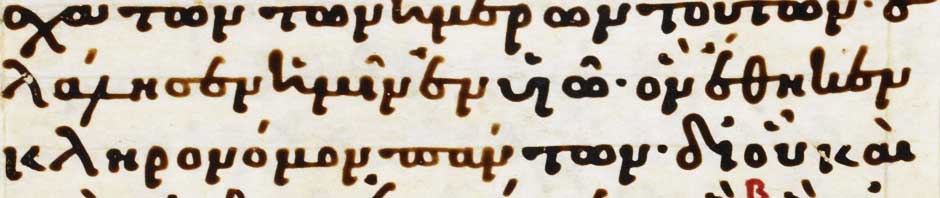
One of the greatest breakthroughs in learning New Testament Greek verbs is understanding that a verb form is not built randomly. Greek verbs are formed from stems. A stem is the part of the verb that carries the basic verbal idea and provides the foundation to which tense markers, voice markers, mood markers, personal endings, infinitive endings, and participle endings are attached.
Students often begin with the lexical form of a verb, such as λύω, γράφω, πιστεύω, ἀγαπάω, or λαμβάνω. However, many Greek verb forms do not look exactly like the lexical form. A student who knows only λαμβάνω may not immediately recognize ἔλαβον. A student who knows only ἔρχομαι may not immediately recognize ἦλθον. A student who knows only λέγω may not immediately recognize εἶπον.
This is why stem identification is essential. Greek verbs are best understood through their principal parts and the stems derived from those principal parts. Once students learn how to identify present stems, future stems, aorist stems, perfect stems, perfect middle/passive stems, and aorist passive stems, Greek verb parsing becomes far more manageable.
What Is a Verb Stem?
A verb stem is the base form from which a particular tense-system is built. It carries the verbal idea and receives the appropriate markers and endings.
For example:
λύω
- λυ- = stem
- -ω = first person singular present active indicative ending
In a simple verb like λύω, the stem is easy to recognize. But in many common verbs, the stem changes from one tense-system to another.
| Lexical Form | Stem Seen in Another Form | Example Form |
|---|---|---|
| λαμβάνω | λαβ- | ἔλαβον |
| ἔρχομαι | ἐλθ- | ἦλθον |
| λέγω | εἰπ- | εἶπον |
| ὁράω | ἰδ- | εἶδον |
Recognizing these stems allows the student to connect unfamiliar forms back to their lexical forms.
Stem Identification and Principal Parts
The principal parts of a Greek verb provide the major tense-system stems. A full verb entry may contain six principal parts.
Example:
λύω, λύσω, ἔλυσα, λέλυκα, λέλυμαι, ἐλύθην
| Principal Part | System | Example | Stem |
|---|---|---|---|
| 1st | Present system | λύω | λυ- |
| 2nd | Future active/middle system | λύσω | λυ- |
| 3rd | Aorist active/middle system | ἔλυσα | λυ- |
| 4th | Perfect active system | λέλυκα | λυ- |
| 5th | Perfect middle/passive system | λέλυμαι | λυ- |
| 6th | Aorist passive system | ἐλύθην | λυ- |
For regular verbs, the stem may remain fairly stable. For irregular verbs, the stems may differ dramatically. This is why students must learn principal parts, especially for high-frequency verbs.
The Present Stem
The present stem is derived from the first principal part. It forms the present and imperfect systems.
Example:
γράφω
- Present stem: γραφ-
- Present active indicative: γράφω
- Imperfect active indicative: ἔγραφον
- Present active infinitive: γράφειν
- Present active participle: γράφων
The present stem often expresses imperfective aspect. It presents the action as in progress, ongoing, repeated, customary, or viewed from within, depending on context.
How to Recognize the Present Stem
The present stem usually appears in present and imperfect forms.
| Form | Stem | Parsing Clue |
|---|---|---|
| γράφω | γραφ- | Present active indicative |
| γράφεις | γραφ- | Present active ending |
| γράφειν | γραφ- | Present active infinitive |
| γράφων | γραφ- | Present active participle |
| ἔγραφον | γραφ- | Imperfect with augment |
The imperfect uses the present stem with augment and secondary endings. Therefore, when students see an augmented form with the present stem, they should consider the imperfect indicative.
Present Stem Additions and Changes
The present stem sometimes contains additions that are not present in other tense stems. This is a major source of confusion.
For example:
| Lexical Form | Present Stem Feature | Aorist Stem |
|---|---|---|
| λαμβάνω | -αν- / nasal element | λαβ- |
| μανθάνω | -αν- / nasal element | μαθ- |
| πάσχω | Expanded present form | παθ- |
| θνῄσκω | Present formation with -σκ- | θαν- |
The present stem may be longer or altered compared with the aorist stem. Students should not assume that the lexical form always reveals the simplest stem.
The Future Stem
The future stem is derived from the second principal part. It forms future active and future middle forms. The future passive is formed differently and is usually based on the aorist passive stem with -θησ-.
Example:
γράφω, γράψω
- Lexical form: γράφω
- Future form: γράψω
- Future stem: γραψ-
The future active often contains -σ-, though the stem may change before that marker.
How to Recognize the Future Stem
| Lexical Form | Future Form | Future Stem |
|---|---|---|
| λύω | λύσω | λυσ- |
| γράφω | γράψω | γραψ- |
| πιστεύω | πιστεύσω | πιστευσ- |
| ἀγαπάω | ἀγαπήσω | ἀγαπησ- |
The future marker is often -σ-, but the visible form may be affected by consonant changes.
Consonant Changes in the Future Stem
When certain consonants combine with -σ-, the spelling changes.
| Stem Ending | With -σ- | Example |
|---|---|---|
| κ, γ, χ | ξ | ἄγω → ἄξω |
| π, β, φ | ψ | γράφω → γράψω |
| τ, δ, θ | σ | πείθω → πείσω |
These changes are essential for identifying future stems. A student who sees γράψω must recognize that ψ represents φ plus σ.
The First Aorist Stem
The first aorist active and middle system is based on the third principal part. It often contains the marker -σα- in the indicative.
Example:
λύω, ἔλυσα
- Aorist stem: λυ-
- Aorist marker: -σα-
- Augment: ἐ-
- Form: ἔλυσα
The first aorist often presents the action as a complete whole, without focusing on its internal process.
How to Recognize the First Aorist Stem
| Form | Clue | Parsing Direction |
|---|---|---|
| ἔλυσα | ἐ- + -σα- | First aorist active indicative |
| λῦσαι | -σαι | Aorist active infinitive |
| λύσας | -σας | Aorist active participle |
| λύσωμεν | -σω- with subjunctive ending | Aorist active subjunctive |
Students must remember that -σ- alone does not always mean future. It may belong to the first aorist system, especially when combined with aorist endings or aorist infinitive and participle patterns.
The Second Aorist Stem
The second aorist uses a different aorist stem without the first aorist -σα- marker. Many high-frequency verbs use second aorists.
Examples:
| Lexical Form | Second Aorist | Second Aorist Stem |
|---|---|---|
| λαμβάνω | ἔλαβον | λαβ- |
| ἔρχομαι | ἦλθον | ἐλθ- |
| λέγω | εἶπον | εἰπ- |
| ὁράω | εἶδον | ἰδ- |
| γίνομαι | ἐγενόμην | γεν- |
Second aorist forms often resemble imperfect forms because they use secondary endings. The key is the stem. If the augmented form uses the present stem, it may be imperfect. If it uses a different aorist stem, it is likely second aorist.
Imperfect versus Second Aorist
This is one of the most important distinctions for students.
| Form | Stem Used | Likely Parsing |
|---|---|---|
| ἔγραφον | Present stem γραφ- | Imperfect active indicative |
| ἔλαβον | Aorist stem λαβ- | Second aorist active indicative |
| ἦγον | Present stem of ἄγω | Imperfect active indicative |
| ἦλθον | Aorist stem of ἔρχομαι | Second aorist active indicative |
The endings may look similar. Stem recognition determines the parsing.
The Perfect Active Stem
The perfect active stem is derived from the fourth principal part. It often includes reduplication and the marker -κα-.
Example:
γράφω, γέγραφα
- Reduplication: γε-
- Stem: γραφ-
- Perfect active marker: -α or -κα- pattern depending on the verb
- Form: γέγραφα
The perfect often presents a completed action with continuing relevance or a state resulting from previous action, depending on context.
How to Recognize the Perfect Active Stem
| Feature | Clue | Example |
|---|---|---|
| Reduplication | Repeated initial consonant with ε | λέλυκα |
| Perfect marker | -κα- | πεπίστευκα |
| Perfect stem | Fourth principal part | γέγραφα |
Reduplication is one of the strongest clues. When students see λε-, γε-, πε-, or another reduplicated pattern, they should immediately consider the perfect system.
The Perfect Middle/Passive Stem
The perfect middle/passive stem is derived from the fifth principal part. It often includes reduplication and middle/passive endings, but it does not usually use -κα-.
Example:
γράφω, γέγραμμαι
- Reduplication: γε-
- Stem: γραμ-
- Ending: -μαι
- System: perfect middle/passive
The perfect middle/passive system may show stem changes caused by consonant interaction with middle/passive endings.
How to Recognize the Perfect Middle/Passive Stem
| Form | Lexical Form | Recognition Clue |
|---|---|---|
| λέλυμαι | λύω | Reduplication + -μαι |
| γέγραμμαι | γράφω | Reduplication + altered stem |
| πεπίστευμαι | πιστεύω | Reduplication + middle/passive ending |
Students should not expect the perfect middle/passive stem always to look exactly like the present stem.
The Aorist Passive Stem
The aorist passive stem is derived from the sixth principal part. It commonly contains -θη- or -η-.
Example:
λύω, ἐλύθην
- Augment: ἐ-
- Stem: λυ-
- Aorist passive marker: -θη-
- Ending: -ν
- Form: ἐλύθην
This same stem helps form aorist passive infinitives and participles.
How to Recognize the Aorist Passive Stem
| Form | Marker | Parsing Direction |
|---|---|---|
| ἐλύθην | -θη- | Aorist passive indicative |
| λυθῆναι | -θη- + -ναι | Aorist passive infinitive |
| λυθείς | -θείς | Aorist passive participle |
| σταυρωθῆναι | -θη- + -ναι | Aorist passive infinitive |
Forms such as σταυρωθῆναι are recognized by combining the stem with the passive marker -θη- and the infinitive ending -ναι.
First Aorist Passive and Second Aorist Passive
Some aorist passive forms use -θη-, while others use -η-. The -θη- pattern is often called first aorist passive, while the -η- pattern is often called second aorist passive.
| Type | Marker | Example |
|---|---|---|
| First aorist passive | -θη- | ἐλύθην |
| Second aorist passive | -η- | ἐγράφην |
The sixth principal part must be learned because not every verb uses the same passive formation.
Stem Changes
Stem changes occur when a verb uses different stems in different tense-systems. These changes may be minor or dramatic.
| Lexical Form | Present Stem | Aorist Stem | Change |
|---|---|---|---|
| λαμβάνω | λαμβαν- | λαβ- | Present stem expanded |
| μανθάνω | μανθαν- | μαθ- | Shorter aorist stem |
| πάσχω | πασχ- | παθ- | Different stem shape |
| γίνομαι | γιν- | γεν- | Vowel change |
Students should learn to expect stem changes in common verbs. The more frequent the verb, the more likely it may have irregular or historically older forms.
Suppletive Stems
A suppletive stem occurs when a verb uses a stem from a different root in one or more tense-systems. These forms cannot be predicted from the lexical form and must be memorized.
| Lexical Form | Suppletive or Irregular Form | System |
|---|---|---|
| λέγω | εἶπον | Aorist active |
| ἔρχομαι | ἦλθον | Aorist active |
| ὁράω | εἶδον | Aorist active |
| φέρω | ἤνεγκον | Aorist active |
Suppletive stems are among the most difficult forms for beginners because they cannot be recognized by simple spelling comparison with the lexical form. They must be learned through principal parts and repeated reading.
Contract Stems
Contract verbs have stems ending in a vowel, usually α, ε, or ο. When endings are added, vowels contract.
Common contract verb types include:
- -άω verbs
- -έω verbs
- -όω verbs
| Lexical Form | Contract Type | Meaning |
|---|---|---|
| ἀγαπάω | -άω | I love |
| ποιέω | -έω | I do, make |
| πληρόω | -όω | I fill, fulfill |
Recognizing Contract Verb Stems
Contract verbs may look different from their lexical form because the stem vowel contracts with the ending.
| Lexical Form | Uncontracted Idea | Contracted Form |
|---|---|---|
| ἀγαπάω | ἀγαπά + ω | ἀγαπῶ |
| ποιέω | ποιέ + ω | ποιῶ |
| πληρόω | πληρό + ω | πληρῶ |
The circumflex accent often helps signal contraction. When students see forms such as ἀγαπῶ, ποιῶ, or πληρῶ, they should consider whether the form comes from a contract verb.
Contract Stems in Other Tense-Systems
Contract verbs often lengthen the contract vowel before tense markers.
| Lexical Form | Future | Aorist |
|---|---|---|
| ἀγαπάω | ἀγαπήσω | ἠγάπησα |
| ποιέω | ποιήσω | ἐποίησα |
| πληρόω | πληρώσω | ἐπλήρωσα |
This vowel lengthening helps students recognize the connection between contracted present forms and other principal parts.
Stem Identification in Compound Verbs
Many Greek verbs are compounds formed with prepositions.
Examples:
- ἀποκρίνω
- ἐκβάλλω
- παραλαμβάνω
- συνέρχομαι
In compound verbs, the augment usually appears after the preposition and before the verbal stem.
| Lexical Form | Aorist Form | Observation |
|---|---|---|
| ἐκβάλλω | ἐξέβαλον | Augment after prefix |
| παραλαμβάνω | παρέλαβον | Aorist stem λαβ- |
| συνέρχομαι | συνῆλθον | Irregular aorist stem |
When analyzing compound verbs, students should separate the prefix from the verbal stem before identifying the tense-system.
How to Identify a Verb Stem Step by Step
- Identify the lexical form if possible.
- Remove obvious endings.
- Look for augment at the beginning of the verb or after a prefix.
- Look for reduplication.
- Look for tense markers such as -σ-, -σα-, -κα-, -θη-, or -θησ-.
- Compare the remaining form with the principal parts.
- Determine which tense-system the stem belongs to.
- Check whether the stem is regular, changed, contracted, or suppletive.
- Confirm the parsing from endings and context.
Fast Stem Recognition Table
| If You See | Think First | Example |
|---|---|---|
| Present stem + primary endings | Present | γράφει |
| Augment + present stem | Imperfect | ἔγραφεν |
| Stem + -σ- | Future or first aorist | γράψει |
| Augment + -σα- | First aorist active indicative | ἔλυσα |
| Augment + different stem + secondary endings | Second aorist | ἔλαβον |
| Reduplication + -κα- | Perfect active | λέλυκα |
| Reduplication + middle/passive endings | Perfect middle/passive | λέλυμαι |
| -θη- | Aorist passive | ἐλύθην |
| -θησ- | Future passive | λυθήσομαι |
Common Student Mistakes
- Assuming the present stem always reveals all other stems.
- Ignoring principal parts.
- Confusing imperfect forms with second aorist forms.
- Assuming every -σ- indicates future.
- Failing to recognize second aorist stems.
- Missing reduplication in perfect forms.
- Confusing aorist passive -θη- with future passive -θησ-.
- Failing to recognize contract stems because of contraction.
- Trying to parse compound verbs without separating the prefix.
- Assuming suppletive forms can be guessed from the lexical form.
Practice Examples
| Form | Lexical Form | Stem | System |
|---|---|---|---|
| ἔλαβον | λαμβάνω | λαβ- | Second aorist |
| γράψει | γράφω | γραψ- | Future |
| γέγραφα | γράφω | γραφ- | Perfect active |
| ἐγράφη | γράφω | γραφ- | Aorist passive |
| ἠγάπησα | ἀγαπάω | ἀγαπη- | First aorist active |
| ἐποίησα | ποιέω | ποιη- | First aorist active |
| εἶπον | λέγω | εἰπ- | Second aorist |
| ἦλθον | ἔρχομαι | ἐλθ- | Second aorist |
Memorization Strategy for Greek Verb Stems
Students should memorize stems in groups rather than isolated forms.
For each common verb, learn:
- Lexical form
- Present stem
- Future stem
- Aorist active/middle stem
- Perfect active stem
- Perfect middle/passive stem
- Aorist passive stem
For example:
γράφω, γράψω, ἔγραψα, γέγραφα, γέγραμμαι, ἐγράφην
From this set, the student can recognize present, future, aorist, perfect, perfect middle/passive, and aorist passive forms of the same verb.
Mastering Greek Verb Stems for Faster Parsing and New Testament Reading
Stem identification is one of the central skills in Greek verb recognition. The present stem forms the present and imperfect systems. The future stem comes from the second principal part. The first aorist stem often uses the -σα- pattern, while the second aorist uses a distinct aorist stem without -σα-. The perfect active stem usually shows reduplication and often -κα-. The perfect middle/passive stem uses reduplication with middle/passive endings. The aorist passive stem commonly uses -θη- or -η-.
Students who learn to identify these stems will parse Greek verbs more accurately and read more fluently. Instead of treating every verb form as a mystery, they will begin to see the structure beneath the surface. By mastering present stems, future stems, aorist stems, perfect stems, passive stems, stem changes, suppletive stems, and contract stems, students gain one of the most important tools for understanding the Greek New Testament.