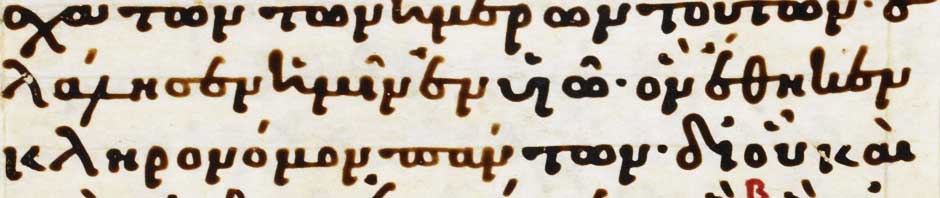
Most Greek nouns follow predictable declensional patterns. Students learn the first declension, second declension, and third declension, and soon become accustomed to recognizing grammatical case, number, and gender from a noun’s ending. However, not every noun conforms neatly to these regular patterns. The Greek New Testament contains irregular nouns, indeclinable nouns, proper names, and numerous foreign names borrowed from Hebrew, Aramaic, Latin, and other languages.
These forms often present challenges to beginning students because they do not always decline according to familiar paradigms. Some appear unchanged regardless of case, while others preserve unusual forms inherited from older stages of the language or from non-Greek linguistic sources.
A thorough understanding of these nouns is essential because they occur frequently throughout the New Testament and often identify key theological figures, geographical locations, ethnic groups, and important concepts.
What Is an Irregular Noun?
An irregular noun is a noun that does not follow the standard declensional patterns expected for its class. The irregularity may involve unusual stem changes, unexpected endings, missing forms, or mixed declensional features.
Not all irregular nouns are completely unpredictable. Many preserve older linguistic patterns that became less common over time. Nevertheless, students must often memorize their forms individually.
Why Irregular Nouns Exist
Languages evolve over centuries. As Greek developed, some nouns retained older forms while others adopted newer patterns. Certain frequently used nouns resisted complete regularization because of their high frequency in everyday speech.
As a result, the New Testament contains a small number of nouns whose forms must simply be learned through repeated exposure.
Important Irregular Nouns in the New Testament
Several common nouns display irregular features.
| Noun | Meaning | Notable Feature |
|---|---|---|
| γυνή | woman, wife | Irregular stem changes |
| ἀνήρ | man, husband | Stem changes throughout declension |
| πατήρ | father | Ancient kinship noun pattern |
| μήτηρ | mother | Ancient kinship noun pattern |
| θυγάτηρ | daughter | Irregular third declension forms |
The Noun γυνή
The noun γυνή (“woman,” “wife”) is extremely common in the New Testament.
| Case | Singular |
|---|---|
| Nominative | γυνή |
| Genitive | γυναικός |
| Dative | γυναικί |
| Accusative | γυναῖκα |
Notice the stem alternation between γυν- and γυναικ-. Students cannot predict every form merely from the nominative.
John 4:17
Οὐκ ἔχω ἄνδρα.
“I do not have a husband.”
The broader narrative repeatedly uses forms of γυνή and illustrates its importance in New Testament discourse.
The Noun ἀνήρ
The noun ἀνήρ (“man,” “husband”) also displays stem changes.
| Case | Singular |
|---|---|
| Nominative | ἀνήρ |
| Genitive | ἀνδρός |
| Dative | ἀνδρί |
| Accusative | ἄνδρα |
The stem changes from ἀνηρ- to ἀνδρ-.
Matthew 1:19
Ἰωσὴφ δὲ ὁ ἀνὴρ αὐτῆς.
“And Joseph her husband.”
Students quickly encounter multiple forms of this noun throughout the New Testament.
The Kinship Nouns
Certain family relationship terms preserve very ancient Indo-European patterns.
Examples include:
- πατήρ — father
- μήτηρ — mother
- θυγάτηρ — daughter
These nouns often display irregular stem formations and should be learned individually.
Matthew 6:9
Πάτερ ἡμῶν ὁ ἐν τοῖς οὐρανοῖς.
“Our Father who is in heaven.”
The vocative Πάτερ is especially important because it appears frequently in prayers and direct addresses.
What Is an Indeclinable Noun?
An indeclinable noun is a noun whose form remains unchanged regardless of case.
Unlike normal Greek nouns, indeclinable nouns do not display distinct nominative, genitive, dative, or accusative endings.
Their grammatical function must be determined from context, articles, prepositions, and syntax.
Why Are Some Nouns Indeclinable?
Most indeclinable nouns entered Greek from foreign languages. Rather than fully adapting them to Greek morphology, speakers often preserved their original forms.
This phenomenon is especially common with Hebrew and Aramaic names.
Common Indeclinable Nouns
| Greek Form | Origin | Meaning |
|---|---|---|
| Ἀβραάμ | Hebrew | Abraham |
| Ἰσαάκ | Hebrew | Isaac |
| Ἰακώβ | Hebrew | Jacob |
| Δαυίδ | Hebrew | David |
| Μαριάμ | Hebrew | Mary |
These forms generally remain unchanged regardless of grammatical function.
Example: Ἀβραάμ
Matthew 1:1
υἱοῦ Δαυίδ, υἱοῦ Ἀβραάμ
“Son of David, son of Abraham.”
Although Ἀβραάμ functions as a genitive relationship within the genealogy, the form itself remains unchanged.
Proper Names in New Testament Greek
Proper names identify specific individuals, places, nations, tribes, rivers, mountains, and cities.
Greek proper names may be:
- Fully declined
- Partially declined
- Indeclinable
Students must therefore evaluate each name individually.
Declinable Proper Names
Some names have been fully adapted to Greek morphology.
Examples include:
| Name | Meaning | Declines? |
|---|---|---|
| Πέτρος | Peter | Yes |
| Παῦλος | Paul | Yes |
| Τιμόθεος | Timothy | Yes |
| Λουκᾶς | Luke | Yes |
These names follow normal Greek declensional patterns.
Example: Πέτρος
| Case | Form |
|---|---|
| Nominative | Πέτρος |
| Genitive | Πέτρου |
| Dative | Πέτρῳ |
| Accusative | Πέτρον |
Because the name has been fully Hellenized, it behaves like an ordinary second-declension noun.
Foreign Names and Their Treatment
The New Testament contains hundreds of names derived from Hebrew and Aramaic sources.
Some are transliterated directly.
Others are partially adapted to Greek pronunciation and spelling.
Still others become fully Greek forms.
This creates a spectrum ranging from completely indeclinable names to fully declined Greek forms.
Hebrew and Aramaic Names
Examples include:
- Ἀβραάμ
- Ἰσαάκ
- Ἰακώβ
- Μωϋσῆς
- Ἠλίας
- Ἰωσήφ
- Σατανᾶς
- Σατᾶν
These names illustrate the variety of ways foreign names were handled in Greek. Some remain completely indeclinable, such as Ἀβραάμ, Ἰσαάκ, and Ἰακώβ. Others were partially or fully adapted to Greek morphology and therefore decline, such as Μωϋσῆς, Ἠλίας, and Σατανᾶς. The shorter form Σατᾶν, however, is generally indeclinable. Each name must therefore be studied individually rather than assigned automatically to a single category.
Partially Hellenized Foreign Names
Some names have Greek endings and therefore decline.
Examples include:
- Μωϋσῆς
- Ἠλίας
- Σατανᾶς
These names entered Greek from foreign languages but became sufficiently adapted to participate in Greek declension. A particularly important example is Μωϋσῆς (“Moses”). Although the name has been adapted to Greek declension, it does not behave exactly like a standard noun. Students will encounter forms such as Μωϋσέως and other variations depending on manuscript tradition and grammatical context. For this reason, Μωϋσῆς is often treated as an irregularly declined foreign name that has been incorporated into the Greek system.
Place Names
Many geographical names also exhibit irregular behavior.
Examples include:
- Ἰερουσαλήμ
- Βηθλεέμ
- Ναζαρέτ
- Γαλιλαία
Some decline normally, while others remain indeclinable.
Determining Case with Indeclinable Nouns
Since indeclinable nouns do not change form, readers must rely on surrounding grammatical clues.
These clues include:
- Articles
- Prepositions
- Word order
- Verbal relationships
- Context
For example, a preposition may clearly indicate that an indeclinable noun functions as the object of that preposition even though its form remains unchanged.
Common Student Mistakes
- Assuming every noun declines normally.
- Trying to force indeclinable nouns into regular paradigms.
- Ignoring articles and prepositions when determining case.
- Confusing transliteration with declension.
- Assuming all foreign names behave identically.
- Failing to memorize common irregular nouns.
Why These Nouns Matter
Many of the most important names in Scripture belong to these categories.
The patriarchs, prophets, apostles, kings, and major geographical locations frequently involve irregular or indeclinable forms.
A student who understands these nouns gains confidence when reading genealogies, narratives, quotations from the Old Testament, and theological discussions involving biblical figures.
Bringing the Categories Together
Irregular nouns, indeclinable nouns, proper names, and foreign names represent important exceptions to the standard declensional system of Greek. Irregular nouns preserve unusual morphological patterns. Indeclinable nouns remain unchanged regardless of case. Proper names may be fully declined, partially declined, or entirely indeclinable. Foreign names reflect the linguistic diversity of the world in which the New Testament was written.
Although these nouns require additional attention, they also reveal the rich historical and cultural background of the New Testament. Mastering them enables students to read the Greek text with greater precision and to recognize the many ways Greek accommodated names and words from other languages while preserving its own grammatical structure.
✓
