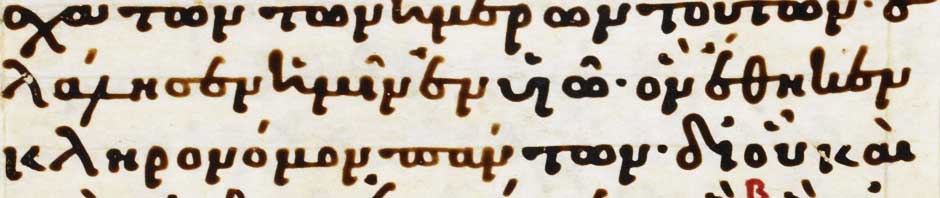
Revelation 12:5
Καὶ ἔτεκεν υἱόν ἄρρενα, ὃς μέλλει ποιμαίνειν πάντα τὰ ἔθνη ἐν ῥάβδῳ σιδηρᾷ καὶ ἡρπάσθη τὸ τέκνον αὐτῆς πρὸς τὸν θεὸν καὶ τὸν θρόνον αὐτοῦ
Transliteration
kai eteken huion arrena, hos mellei poimainein panta ta ethnē en rhabdō sidēra kai hērpasthē to teknon autēs pros ton theon kai ton thronon autou
Literal Translation
“And she gave birth to a son, a male, who is about to shepherd all the nations with an iron rod, and her child was snatched away to God and to His throne.”
Grammar Focus
μέλλει + Infinitive
μέλλει ποιμαίνειν combines the verb μέλλω with an infinitive.
This construction often expresses an action that is destined, impending, or certain to happen.
The Passive Verb
ἡρπάσθη is an aorist passive verb meaning “was snatched away.”
The passive form places emphasis on the child being acted upon rather than performing the action.
Vocabulary Builder
ποιμαίνω
Meaning: “to shepherd” or “to rule”
Form in Verse: ποιμαίνειν
The verb originally refers to tending sheep but is often used metaphorically for royal rule or leadership.
ῥάβδος
Meaning: “rod” or “staff”
Form in Verse: ῥάβδῳ
Often symbolizes authority, discipline, or royal power.
ἁρπάζω
Meaning: “to seize” or “to snatch away”
Form in Verse: ἡρπάσθη
The word carries a sense of sudden and forceful movement.
Syntax Insight
The sentence begins with birth imagery, moves into future authority, and concludes with exaltation toward God’s throne.
The relative clause expands the identity of the child before the narrative shifts to the passive rescue action.
| Element | Greek | Function |
|---|---|---|
| Main Verb | ἔτεκεν | “She gave birth” |
| Direct Object | υἱόν ἄρρενα | “a son, a male” |
| Relative Clause | ὃς μέλλει ποιμαίνειν | describes the mission of the child |
| Instrument Phrase | ἐν ῥάβδῳ σιδηρᾷ | “with an iron rod” |
| Passive Verb | ἡρπάσθη | “was snatched away” |
Practice Prompt
- What does μέλλει add to the infinitive ποιμαίνειν?
- Identify the case of πάντα τὰ ἔθνη.
- Why is ἡρπάσθη considered passive?
- Translate ἐν ῥάβδῳ σιδηρᾷ literally.
