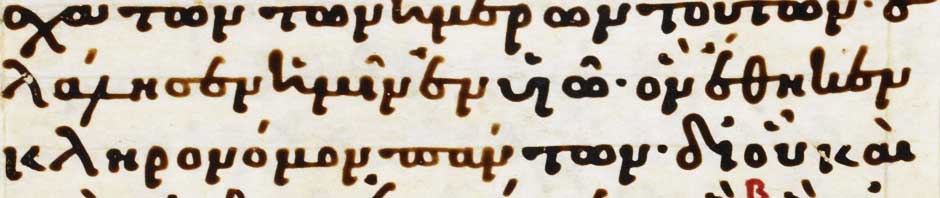
1 Corinthians 1:30
Ἐξ αὐτοῦ δὲ ὑμεῖς ἐστε ἐν Χριστῷ Ἰησοῦ, ὃς ἐγενήθη ἡμῖν σοφία ἀπὸ Θεοῦ, δικαιοσύνη τε καὶ ἁγιασμὸς καὶ ἀπολύτρωσις,
1. A Sentence That Keeps Adding New Facets
Imagine turning a precious gem in the sunlight. Each movement reveals another side.
That is what Greek does in this verse.
Paul begins with Christ and then keeps adding descriptions:
wisdom
righteousness
sanctification
redemption
Instead of explaining Christ through long paragraphs, Greek paints a portrait using a series of powerful nouns.
2. Transliteration
ex aftú dhe imís este en Christó Iisú, os egheníthi imín sofía apó Theú, dhekeosíni te ke aghiasmós ke apolítrosis.
3. Literal Translation
“But from Him you are in Christ Jesus, who became for us wisdom from God, both righteousness and sanctification and redemption.”
4. Grammar Focus: One Person, Many Descriptions
The most important feature in this verse is the chain of predicate nouns following the verb:
σοφία
δικαιοσύνη
ἁγιασμός
ἀπολύτρωσις
All these nouns describe what Christ has become for believers.
Notice that Paul does not write:
“Christ gives wisdom.”
“Christ gives righteousness.”
Instead, the sentence is stronger:
Christ became wisdom.
Christ became righteousness.
Christ became sanctification.
Christ became redemption.
The grammar presents these blessings not merely as gifts from Christ but as realities found in Him.
5. Vocabulary Builder: Four Precious Words
| Greek Word | Meaning | Beginner Insight |
|---|---|---|
| σοφία | wisdom | True wisdom comes from God rather than human pride. |
| δικαιοσύνη | righteousness | A word associated with being right before God. |
| ἁγιασμὸς | sanctification | The process and reality of being set apart for God. |
| ἀπολύτρωσις | redemption | Liberation through a price being paid. |
| ἐγενήθη | became | The verb linking Christ with all the descriptions that follow. |
| ἐν Χριστῷ Ἰησοῦ | in Christ Jesus | A favorite Pauline expression for union with Christ. |
6. Syntax Insight: The Sentence Climbs Like a Staircase
This verse has a staircase structure.
Each noun adds another step:
wisdom → righteousness → sanctification → redemption
Rather than stopping after one description, Greek continues upward.
The conjunctions:
τε καὶ … καὶ
help connect the final items into one unified portrait.
The effect is cumulative. Each term broadens the reader’s understanding of who Christ is for believers.
By the end of the verse, the sentence feels richer than it did at the beginning because every new noun adds another layer of meaning.
7. Beginner Practice Activity: Find the Word for Redemption
Which Greek word means “redemption”?
| Greek Word | Meaning? |
|---|---|
| σοφία | ? |
| ἁγιασμὸς | ? |
| ἀπολύτρωσις | ? |
Click to Reveal the Answer
Answer: ἀπολύτρωσις.
ἀπολύτρωσις means “redemption” or “release.” It refers to liberation through the payment of a price and forms the final step in Paul’s chain of descriptions.
What the Chain of Nouns Quietly Reveals
This verse is remarkable because it contains very little narrative movement. No journeys occur. No conversations unfold.
Instead, the power comes from a growing series of descriptions:
- wisdom
- righteousness
- sanctification
- redemption
Greek builds meaning through accumulation. Each noun contributes another facet to the portrait.
By the end of the sentence, the reader has moved from a simple statement about being “in Christ Jesus” to a rich understanding of what Christ has become for believers.
The grammar quietly teaches that the blessings are not scattered across different sources. They are gathered together in one person.

