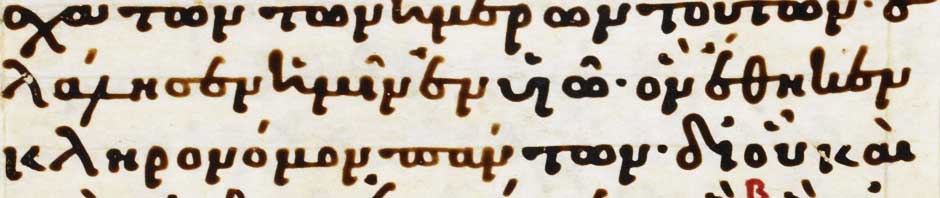
Hebrews 11:34
ἔσβεσαν δύναμιν πυρός ἔφυγον στόματα μαχαίρας ἐνεδυναμώθησαν ἀπὸ ἀσθενείας ἐγενήθησαν ἰσχυροὶ ἐν πολέμῳ παρεμβολὰς ἔκλιναν ἀλλοτρίων
A Verse That Moves Like Marching Footsteps
This verse does not slow down to explain each event carefully.
Instead, Greek drives forward through a rapid chain of verbs:
quenched → escaped → were strengthened → became strong → turned back
The sentence feels forceful because the verbs come one after another without long pauses. Greek sometimes creates emotional intensity simply through rhythm and momentum.
Transliteration
esbesan dynamin pyros ephygon stomata machairas enedynamōthēsan apo astheneias egenēthēsan ischyroi en polemō parembolas eklinan allotriōn
Literal Translation
“They quenched the power of fire, escaped the mouths of the sword, were strengthened from weakness, became mighty in war, and turned back armies of foreigners.”
Grammar Focus — A Chain of Aorist Verbs
Nearly every major action in this verse appears in the aorist tense.
The aorist often presents actions as complete events.
ἔσβεσαν
“they quenched”
ἔφυγον
“they escaped”
ἐγενήθησαν
“they became”
Greek uses repeated aorist verbs here almost like hammer strikes. Each action lands strongly before the next one arrives.
The rhythm gives the verse energy and momentum.
Vocabulary Builder — Strong Images in Greek
| Greek Word | Pronunciation | Meaning | Beginner Insight |
|---|---|---|---|
| πυρός | pyros | fire | A vivid image often connected with danger or judgment. |
| μαχαίρας | machairas | sword | Greek sometimes speaks of “the mouth of the sword” poetically. |
| ἀσθενείας | astheneias | weakness | Can refer to physical weakness, limitation, or frailty. |
| πολέμῳ | polemō | war | The source of English words like “polemic.” |
The Greek Expression “Mouths of the Sword”
One striking phrase in the verse is:
στόματα μαχαίρας
Literally:
“mouths of the sword”
Greek sometimes uses vivid body imagery metaphorically.
The sharp edge of the sword is pictured like a devouring mouth.
This kind of expression makes the language feel dramatic and visual rather than flat.
How the Sentence Climbs Upward
The verse moves upward in intensity:
danger survived
↓
weakness overcome
↓
strength in war
↓
enemy armies driven back
Greek arranges the actions almost like increasing waves of victory.
The sentence begins with survival and ends with triumph.
Beginner Practice Activity
Match the Greek word with its meaning.
| Greek | Your Match |
|---|---|
| πυρός | A. weakness |
| ἀσθενείας | B. fire |
| πολέμῳ | C. war |
Small Grammar Challenge: Which repeated tense gives the verse its rapid, forceful rhythm?
Listening to the Rhythm of the Verbs
This verse teaches beginners that Greek can create emotional force through structure alone.
The rapid aorist verbs keep the sentence moving forward without pause. The vivid imagery of fire, swords, weakness, war, and armies fills the verse with intensity. And the movement from weakness to strength gives the passage a rising sense of victory.
As you continue reading Greek, you begin noticing how grammar itself can shape pace, emotion, and momentum inside a sentence.

