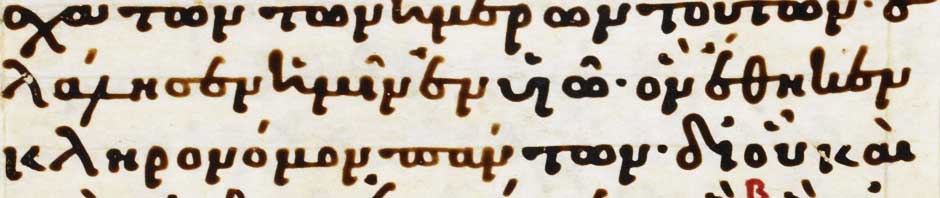
Καὶ ἔζησεν Σαλα μετὰ τὸ γεννῆσαι αὐτὸν τὸν Εβερ τριακόσια τριάκοντα ἔτη καὶ ἐγέννησεν υἱοὺς καὶ θυγατέρας καὶ ἀπέθανεν (Genesis 11:15 LXX)
And Sala lived after he begot Eber three hundred thirty years, and he begot sons and daughters, and he died.
Grammatical Insight
This verse from Genesis 11:15 in the Septuagint exemplifies the stark simplicity of genealogical Greek, where syntax carries the weight of sacred history. The verb ἔζησεν (aorist active indicative of ζάω) opens the verse with a completed life-event, framing existence as a bounded whole. The temporal construction μετὰ τὸ γεννῆσαι employs μετά with an articular infinitive, a distinctly Greek way of marking time “after the act of begetting.” The infinitive γεννῆσαι focuses attention on lineage rather than chronology, anchoring time to generational succession. The accusative phrase τριακόσια τριάκοντα ἔτη functions as a measure of duration, extending life across centuries while remaining grammatically subordinate to the verb of living. The coordinated aorist ἐγέννησεν resumes narrative motion, marking procreation as the central action within that long span. The compound object υἱοὺς καὶ θυγατέρας intentionally broadens the genealogical horizon beyond a single heir, signaling abundance and continuity. The final verb ἀπέθανεν, stark and unadorned, closes the verse with grammatical finality. Through its sequence of aorists, the syntax traces a complete human arc: life, fruitfulness, and death.
Exploring the Verse as a Living Lesson
Imagine a scribe carefully copying this line, aware that every verb he writes compresses centuries into a single sentence. A student reading the verse might wonder why the Greek feels so restrained, so repetitive. The teacher points to the verbs: ἔζησεν, ἐγέννησεν, ἀπέθανεν—each one decisive, each one final. The grammar teaches that human life is not narrated through emotions or achievements but through continuity. The phrase μετὰ τὸ γεννῆσαι reminds the reader that time itself is measured by relationships, not by abstract numbers. The repeated use of the aorist tense gives the genealogy a solemn cadence, as if each life is a completed offering. The verse becomes a lesson in perspective: grammar disciplines the reader to see history not as chaos, but as ordered succession. In this way, linguistic economy becomes theological clarity.
Where Syntax Meets Revelation
The theology of this verse emerges directly from its grammatical structure. The aorist tense throughout denies any illusion of permanence—every life is complete, bounded, and concluded. Yet the placement of ἐγέννησεν between living and dying reveals divine purpose within mortality: continuity through generation. The temporal construction with μετά ensures that life after begetting is not aimless but meaningful, oriented toward legacy. Even the silence of the text—what it does not describe—becomes revelatory, as syntax refuses to linger on individual achievement. The repeated pattern across genealogies teaches that covenant history advances through obedience to creation’s mandate rather than heroic narrative. Grammar thus becomes revelation: the form of the sentence proclaims that divine faithfulness works through ordinary human rhythms. In the economy of the Septuagint, syntax itself preaches endurance through succession.
Form and Function Table
| Greek Word | Root | Form | Lexical Meaning | Grammatical Role | Notes / Usage |
|---|---|---|---|---|---|
| ἔζησεν | ζάω | Aorist Active Indicative 3rd Singular | he lived | Main verb | Summarizes an entire lifespan as a completed whole. |
| γεννῆσαι | γεννάω | Aorist Active Infinitive | to beget | Temporal infinitive | Marks generational pivot rather than simple chronology. |
| ἐγέννησεν | γεννάω | Aorist Active Indicative 3rd Singular | he begot | Narrative verb | Centers the verse on continuity of lineage. |
| ἀπέθανεν | ἀποθνῄσκω | Aorist Active Indicative 3rd Singular | he died | Terminal verb | Closes the life-cycle with grammatical finality. |
The Spirit in the Syntax
This genealogy does not merely record ages and names; it shapes a theology of time through grammar. The measured verbs remind readers that every life is complete in the divine record, no matter how long or brief. The syntax teaches patience, continuity, and humility before the span of generations. By refusing embellishment, the Greek allows the rhythm of life itself to speak. Living, begetting, and dying become sacred movements, repeated faithfully across history. In this quiet verse, grammar bears witness to divine order, showing how the covenant advances one completed life at a time. The Spirit, it seems, moves even through the simplest clauses, guiding history through syntax.

