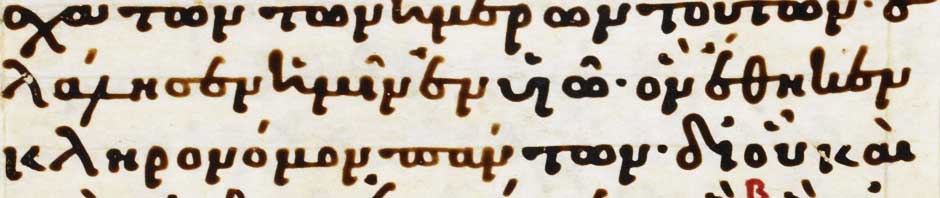
The crowd stirs as Jesus speaks, dust flickering in the sunlit air. His words gather the entire prophetic tradition into a single grammatical arc – nouns bending toward a moment where history tightens like a bowstring.
Πάντες γὰρ οἱ προφῆται καὶ ὁ νόμος ἕως Ἰωάννου ἐπροφήτευσαν·
For all the prophets and the Law prophesied until John.
οἱ προφῆται … πάντες
ὁ νόμος
Ἰωάννου
Green (#2a9d8f) marks chains of article–noun agreement or proper-name declension that establish the grammatical horizon of prophetic activity.
The Story the Endings Tell
Morphology Spotlight
1. πάντες — NOM.PL.M of πᾶς (“all”)
| Case | Masc | Fem | Neut |
|---|---|---|---|
| Nom | πάντες | πᾶσαι | πάντα |
| Gen | πάντων | πασῶν | πάντων |
| Dat | πᾶσι(ν) | πάσαις | πᾶσι(ν) |
| Acc | πάντας | πάσας | πάντα |
This masculine nominative plural signals a collective: a united prophetic chorus, each voice bearing witness through its shared ending.
2. οἱ προφῆται — NOM.PL.M of προφήτης (“prophet”)
| Case | Singular | Plural |
|---|---|---|
| Nom | προφήτης | προφῆται |
| Gen | προφήτου | προφητῶν |
| Dat | προφήτῃ | προφήταις |
| Acc | προφήτην | προφήτας |
The nominative plural pairs with πάντες to form a grammatical chain of total inclusivity: all the prophets stand shoulder-to-shoulder.
3. ὁ νόμος — NOM.SG.M of νόμος (“law”)
| Case | Singular | Plural |
|---|---|---|
| Nom | νόμος | νόμοι |
| Gen | νόμου | νόμων |
| Dat | νόμῳ | νόμοις |
| Acc | νόμον | νόμους |
The nominative singular rides alongside the nominative prophets: “the Law” joins the prophetic choir as a second subject in the great anticipatory movement toward John.
4. Ἰωάννου — GEN.SG.M of Ἰωάννης (“John”)
| Case | Singular | Plural |
|---|---|---|
| Nom | Ἰωάννης | Ἰωάννηδες |
| Gen | Ἰωάννου | Ἰωαννῶν |
| Dat | Ἰωάννῃ | Ἰωάννοις |
| Acc | Ἰωάνην | Ἰωάννας |
The genitive marks John as a temporal boundary—“until John”—a grammatical milestone indicating the turning point where prophetic expectation yields to fulfillment.
If Matthew had used the accusative instead of the genitive for Ἰωάννης, what nuance would change?
The sense of “up to the era of John” would vanish, replaced by an object-like reference lacking temporal boundary force.
Syntax Cubes
[πάντες] — collective subject
   [οἱ προφῆται] — core nominative plural
      [καὶ ὁ νόμος] — coordinated nominative subject
          [ἕως Ἰωάννου] — temporal boundary (GEN)
              [ἐπροφήτευσαν] — main verb
Semantic Force
The nominatives gather a unified witness; the genitive draws the finish line. The verb completes the motion: the entire prophetic tradition pushes forward until it strikes the threshold of John the Baptist.
When Agreement Preaches
Article–Noun Choreography
οἱ προφῆται and ὁ νόμος are the grammatical twin pillars of Israel’s testimony. Their nominative stance communicates solidarity: they point with one voice toward the arrival of the One who surpasses both.
Proper-Name Declension as Theology
Ἰωάννου is not just a genitive; it is a horizon-maker. It declares an “until” that reshapes the entire interpretive landscape.
If Matthew had written ἕως Ἰωάννης (nominative), what would break?
The phrase would lose its idiomatic temporal meaning and collapse syntactically.
What If the Paradigm Bent?
Comparative Hypothetical
Imagine if ὁ νόμος were plural—οἱ νόμοι. Matthew’s delicate symmetry of “all the prophets *and the law*” would fracture into competing legal voices. The singular nominative preserves the idea of Torah as a unified testimony, not a collection of isolated statutes.
Because the gospel does not emerge from competing witnesses but from a single, converging anticipation.
The Moment Before the Dawn
Imagine standing at the edge of night while a long procession of prophets marches past you, lanterns glowing in their hands. Last of all comes the lone figure of John, and as he passes, the torchlight shifts—revealing the brightening sky behind him. Matthew’s grammar shows you what the prophets saw: their task was real, beautiful, but incomplete. They walked you to the threshold. Beyond it, the sun itself steps forward.
