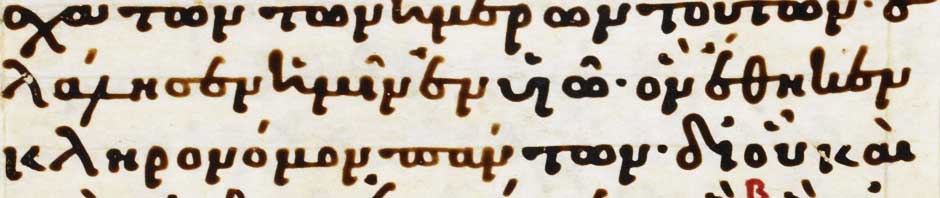
ἢ καὶ ἐὰν αἰτήσει ᾠόν, μὴ ἐπιδώσει αὐτῷ σκορπίον; (Luke 11:12)
Or if he asks for an egg, will he give him a scorpion?”
Some verses whisper grammar; others shout it. Luke 11:12 stages a tiny household drama: a child’s request, a parent’s response, an egg, a scorpion, and a question that expects a shocked “Of course not!” from the hearer. Through this vivid image, Koine Greek shows you how real people framed conditions, requests, and rhetorical questions in everyday speech. This is not grammar in a museum; it is grammar in a kitchen.
In this lesson, we will treat ἢ καὶ ἐὰν αἰτήσει ᾠόν, μὴ ἐπιδώσει αὐτῷ σκορπίον; as a living sentence you can reuse. We will contrast it with a Classical-style analogue that could easily appear in the pages of Plato or Demosthenes, so that every difference between Koine and Classical becomes a tool in your hands. The goal is simple and demanding: when you finish, you should be able to compose your own Greek conditionals about real life without reaching for a grammar book.
For learners: Treat Luke 11:12 as a reusable speaking pattern for everyday “if X, will Y?” questions in your own Greek.
1. The Verb at the Center: αἰτέω and ἐπιδίδωμι in Real Requests
At the heart of the verse stand two verbal actions: the asking and the giving. Koine makes you feel the interpersonal relationship with the future forms αἰτήσει and ἐπιδώσει. In Classical Attic, the core pair of verbs would be the same or very similar, but the choice of tense and mood in the conditional structure could shift.
Our Koine text reads: ἐὰν αἰτήσει ᾠόν — literally, “if he will ask for an egg.” Many grammars would have expected a subjunctive here (αἰτήσῃ) after ἐάν, and indeed that is more typical, especially in Classical Attic. But Koine is relaxed and practical; the future indicative form functions here in a way close to “whenever he asks” or “if he happens to ask.” The parent’s perspective looks forward to the request as a definite possibility.
For the second verb, μὴ ἐπιδώσει αὐτῷ σκορπίον;, we again meet the future indicative: “surely he will not give him a scorpion, will he?” This is not a neutral future prediction; it is a rhetorical question with an implied “No!” In lively speech, you should hear a rising, incredulous tone: “He’s not going to give him a scorpion, is he?”
A Classical-style analogue, shaped as an Attic rhetorical question, might look like this for teaching purposes:
ἐάν τις αἰτήσῃ ᾠόν, μῶν ἐπιδώσει αὐτῷ σκορπίον;
Here the Attic flavor appears in the more “typical” αἰτήσῃ (aorist subjunctive) and the particle μῶν, often used in questions that expect a negative answer. Feeling that shift in tone and mood helps you sense how Koine is both heir to and simplifier of Classical patterns.
For learners: When composing Koine, confidently use future forms like αἰτήσει and ἐπιδώσει in vivid, real-life conditional scenes to sound natural and concrete.
2. Morphology Clinic: Every Word Pulling Its Weight
Now we open the sentence like a precision instrument, looking at each form so that you can later rebuild the pattern in your own writing.
| Word | Morphology | Basic Meaning | Function in the Verse |
|---|---|---|---|
| ἤ | Coordinating conjunction | or | Connects this question with the previous one, adding another example. |
| καί | Coordinating particle | and, also | Intensifies the alternative: “or even…”, heightening the rhetorical force. |
| ἐάν | Conditional particle | if, whenever | Introduces a conditional clause, normally followed by a subjunctive in Classical usage. |
| αἰτήσει | Future active indicative, 3rd singular of αἰτέω | he will ask | Verb of the protasis (“if-clause”), marking a future request. |
| ᾠόν | Accusative singular neuter noun | egg | Direct object of αἰτήσει, the requested item. |
| μή | Negative particle | not | Signals a negative expectation in a rhetorical question: “surely not…?” |
| ἐπιδώσει | Future active indicative, 3rd singular of ἐπιδίδωμι | he will give | Main verb of the apodosis (“then-clause”), expressing the (denied) shocking action. |
| αὐτῷ | Dative singular masculine pronoun | to him | Indirect object: the child who would receive the gift. |
| σκορπίον | Accusative singular neuter noun | scorpion | Direct object of ἐπιδώσει; the grotesquely inappropriate “gift.” |
By rehearsing these forms, you train your eye to connect endings with roles in the sentence. The dative αὐτῷ silently answers “to whom?”, while the accusatives ᾠόν and σκορπίον showcase how the same case can carry both innocent and dangerous contents.
For learners: Memorise αἰτήσει and ἐπιδώσει as a pair so you can quickly build “ask X, give Y” sentences with the correct cases and roles.
3. Syntax in Motion: From Condition to Rhetorical Question
Syntactically, the verse is a compact conditional question. We begin with the protasis, the “if-clause”: ἐὰν αἰτήσει ᾠόν. This sets the scene: a request for something good and harmless. The apodosis follows as a rhetorical question: μὴ ἐπιδώσει αὐτῷ σκορπίον;
Notice how the **negative particle** μή combines with the future verb to create a strong expectation: “He’s not going to do this, is he?” The force is similar to English tag-questions with a built-in answer: “He wouldn’t give him a scorpion, would he?”
Classical Attic would often realise the same thought with a more canonical structure, such as:
ἐάν τις αἰτήσῃ ᾠόν, μῶν ἐπιδώσει αὐτῷ σκορπίον;
Here the aorist subjunctive αἰτήσῃ follows ἐάν, aligning with Attic expectations, and the particle μῶν colours the question as almost sarcastically incredulous. Koine Luke, in contrast, relies less on specialised particles and more on familiar future forms and an emotional contrast between ᾠόν and σκορπίον.
The syntax is simple, but its impact is sharp: like a door that swings freely because the hinges are well-fitted, the sentence moves from a harmless request to a shocking hypothetical outcome in a single breath.
For learners: When you want a sharp, emotional “surely not” question in Koine, combine μή with a future indicative in a simple conditional structure.
4. Syntax Sandbox: Playful Transformations
1) ἢ καὶ ἐὰν αἰτήσει ᾠόν, μὴ ἐπιδώσει αὐτῷ σκορπίον;
2) ἢ καὶ ἐὰν αἰτήσῃ ᾠόν, μὴ ἐπιδώσει αὐτῷ σκορπίον;
3) ἢ καὶ ἐὰν αἰτηθῇ ᾠόν, μὴ ἐπιδωθήσεται αὐτῷ σκορπίον;
4) ἢ καὶ μὴ ἐπιδώσει αὐτῷ σκορπίον, ἐὰν αἰτήσει ᾠόν;
Translate each aloud. What nuance shifts?
For learners: Use tiny syntactic experiments like these to feel how tense, voice, and word order reshape the emotional contour of your Greek sentences.
5. Koine vs Classical: A Production-Driven Comparison
To help you actively produce Greek, we compare key features of Luke 11:12 with a Classical-style analogue and give you a three-word “production tip” phrase for each. This table is not for passive admiration; it is a launchpad for your own composition.
| Feature | Koine (NT) | Classical Attic | Production Tip |
|---|---|---|---|
| Conditional marker | ἐάν with future indicative | ἐάν with aorist subjunctive | ἐάν τι ζητῇ |
| Verb of asking | αἰτήσει (future indicative) | αἰτήσῃ (aorist subjunctive) | αἰτήσῃ βοήθειαν |
| Negative rhetorical question | μὴ ἐπιδώσει…; | μῶν ἐπιδώσει…; | μὴ δώσει τι |
| Word order | Verb–object–indirect object | Often similar, but more flexible with particles | δώσει τῷ παιδί |
| Imagery | Household, food, danger | Could be framed for lawcourt or philosophy | αἰτήσῃ σιτία |
Read each “Production Tip” aloud and then adapt it. For example, from δώσει τῷ παιδί (“he will give to the child”), try δώσεις τῷ ἀδελφῷ (“you will give to the brother”). The differences between Koine and Classical morphology and particles become your creative palette.
For learners: Use side-by-side Koine–Classical mini-phrases as templates, swapping nouns and persons to build your own fluent conditional and rhetorical sentences.
Koine Trap: Do not assume ἐάν always demands a subjunctive; in Koine, future indicatives like αἰτήσει can appear and still function conditionally.
6. Echo Chamber: Let Classical Resonance Shape Your Koine
To deepen your instinct for style, we will let a Classical-sounding line “echo” Luke’s sentence, then deliberately twist it back into Koine. Think of this as tuning your ear on an older instrument so you can play more confidently on your everyday one.
First, here is a Classical-style clause a rhetor in Athens might like:
ἐάν τις αἰτήσῃ ἀγαθόν, μῶν ἐπιδώσει αὐτῷ κακόν;
The structure is familiar: conditional particle ἐάν, subjunctive verb αἰτήσῃ, and a pungent particle μῶν to mark a negative answer. But instead of Luke’s egg and scorpion, we simply contrast “good” and “evil.”
Now the imitation directive:
Now imitate this Classical clause with a Koine twist: replace the optative or particle flavor with a simple subjunctive or future and drop μῶν.
A Koine-style echo might be:
ἐὰν αἰτήσῃ ἀγαθόν, μὴ ἐπιδώσει αὐτῷ κακόν;
This Koine version feels closer to Luke: ἐὰν with a familiar subjunctive, μή plus future indicative, no exotic particles. Your Greek becomes serviceable for narrative and teaching, not just high rhetoric.
For learners: Practise “Koine-izing” Classical clauses by simplifying particles and using μή + future indicative for strong negative expectations.
7. Application: Turning Eggs and Scorpions into Your Own Greek
Grammar only becomes yours when you risk expressing your own meanings. Imagine daily scenes where Luke’s pattern would fit: a teacher promising not to give confusing explanations, a friend refusing to respond harshly to an honest question, a parent assuring a child of kindness.
Try building mini-dialogues using the backbone:
ἐὰν αἰτήσῃς σοφίαν, μὴ ἐπιδώσει σοι ἀγνοίαν; — “If you ask for wisdom, will he give you ignorance?”
ἐὰν αἰτήσῃς βοήθειαν, μὴ ἐπιδώσουσι σοι βλάβην; — “If you ask for help, will they give you harm?”
Notice how the structure bends without breaking. You can swap in new nouns: ἄρτον, βίβλον, συμβουλήν, χαράν. You can change the subject: ἐὰν ὁ φίλος αἰτήσῃ, ἐὰν οἱ μαθηταὶ αἰτήσωσιν. The pattern is a mold; the vocabulary is your molten metal.
Remember that aspect in Greek is like the texture of time on your sentence: the aorist is not a timestamp; it is a seal on a decree, a single stamped decision. When you choose between future and aorist subjunctive in conditions, you are choosing how definite or “sealed” the event feels in your mind.
Use Luke 11:12 as your workshop. Speak it aloud, alter the nouns, alter the subjects, then alter the verbs: ἐὰν ἐρωτήσει, ἐὰν ζητήσῃ, ἐὰν ἐλπίσει. Each variation deepens your command of how Greek speakers framed expectations and reassurances.
For learners: Treat the whole sentence as a pattern to fill with new subjects and objects until you can improvise reassuring or challenging questions in Greek without hesitation.
8. From Kitchen Table to Classroom
Luke 11:12 is a kitchen-table question that has become a classroom treasure. In one short line, you have practised conditional structure, future forms, rhetorical questions, Koine versus Classical stylistic choices, and concrete vocabulary that you can reuse in countless scenes. You have listened to a Classical echo and answered it in Koine; you have played in a syntax sandbox; you have watched verbs and particles trade places as the meaning shifts.
Do not file this verse away as “covered.” Instead, revisit it like a musician revisits a scale, or like a craftsman who checks the edge of a tool before work. The more you internalise patterns like ἐὰν αἰτήσει ᾠόν, μὴ ἐπιδώσει αὐτῷ σκορπίον;, the more your Greek will move from cautious decoding to confident creation.
Now compose five Greek words that echo today’s grammar lesson and share them with a fellow learner.
Ἀπὸ τοῦ ᾠοῦ ἐπὶ τὸν σκορπίον: ὅτε ἡ γραμματικὴ γίνεται πίστις.
