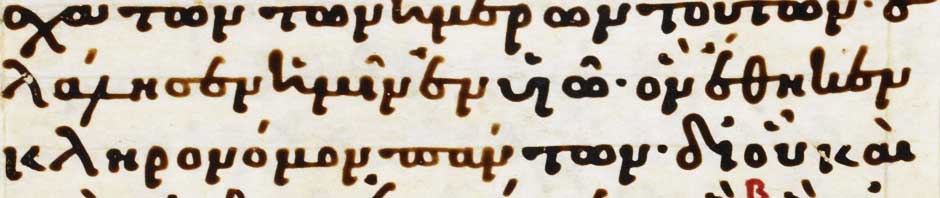
Genesis 1:18 (Septuagint)
Καὶ ἄρχειν τῆς ἡμέρας καὶ τῆς νυκτὸς καὶ διαχωρίζειν ἀνὰ μέσον τοῦ φωτὸς καὶ ἀνὰ μέσον τοῦ σκότους καὶ εἶδεν ὁ Θεὸς ὅτι καλόν.
1. Transliteration
ke árhin tis iméras ke tis nyktós ke dhiakhorízin aná méson tu fotós ke aná méson tu skótus ke ídhen o Theós óti kalón
2. Literal Translation
“And to rule the day and the night, and to separate between the light and between the darkness, and God saw that it was good.”
3. The Verse Feels Like a Flow of Purpose
This Greek sentence does not move quickly toward the final statement. Instead, it slowly unfolds the purpose of the heavenly lights. The rhythm feels deliberate. Greek keeps adding action after action:
ἄρχειν → “to rule”
διαχωρίζειν → “to separate”
εἶδεν ὁ Θεὸς → “and God saw”
The sentence first shows the function of creation before giving God’s evaluation of it. The Greek lets the reader experience order being established step by step.
4. Grammar Focus: The Infinitives That Describe Purpose
The main grammar feature in this verse is the use of infinitives:
ἄρχειν = “to rule”
διαχωρίζειν = “to separate”
An infinitive often expresses purpose or function. Here, the infinitives explain why the lights exist.
For beginners, this feels similar to English expressions like:
“created to rule”
“appointed to separate”
Greek loves this flowing structure. Instead of stopping after one action, it keeps unfolding the mission of creation through infinitives.
The effect is beautiful and orderly. The sentence sounds like creation being carefully arranged.
5. Vocabulary Workshop: Words That Shape the Cosmos
| Greek Word | Meaning | Beginner Insight |
|---|---|---|
| ἄρχειν | to rule | This word gives the lights authority over time. |
| ἡμέρας | day | Greek often places opposite ideas together: day and night. |
| νυκτὸς | night | The pairing creates balance inside the sentence. |
| διαχωρίζειν | to separate | Creation in Genesis often happens through separation and order. |
| φωτὸς | light | Light appears before many other created structures. |
| σκότους | darkness | Greek visually balances light and darkness in parallel form. |
6. Syntax Insight: Greek Builds the Scene Through Repetition
One beautiful feature in this verse is repetition:
καὶ … καὶ … καὶ … καὶ
The repeated καὶ (“and”) creates a slow, steady rhythm. The sentence feels like one layer of creation being added after another.
Greek does not rush to the ending. It allows the reader to watch order emerge:
- rule the day
- rule the night
- separate light
- separate darkness
- God sees the goodness
The syntax feels architectural. Each phrase builds on the previous one until the sentence finally arrives at:
καὶ εἶδεν ὁ Θεὸς ὅτι καλόν
Only after the functions are complete does the divine evaluation appear.
7. Beginner Practice Activity: Identify the Infinitive
Which TWO Greek words in the verse are infinitives?
| Greek Word | Is It an Infinitive? |
|---|---|
| ἄρχειν | ? |
| φωτὸς | ? |
| διαχωρίζειν | ? |
Click to Reveal the Answer
Answer: ἄρχειν and διαχωρίζειν are infinitives.
Both words describe purpose or function. They explain what the heavenly lights are meant to do. φωτὸς is not an infinitive. It means “light.”
How the Greek Slowly Builds an Ordered World
This verse shows how Greek can create a feeling of calm structure through infinitives, repetition, and pacing. The sentence moves carefully from one purpose to another. Nothing feels random.
The heavenly lights are not merely shining objects. In Greek, they are presented as servants of order:
- ruling
- separating
- organizing
- bringing distinction
Only after this ordered movement does the sentence finally arrive at God’s evaluation:
καὶ εἶδεν ὁ Θεὸς ὅτι καλόν.
“And God saw that it was good.”
The Greek allows the reader to feel the beauty of order before hearing the declaration of goodness.

