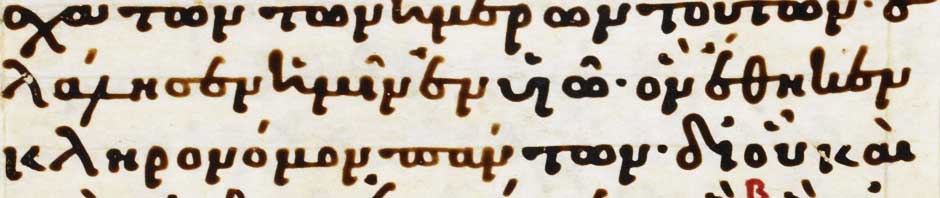
Πάντα μοι παρεδόθη ὑπὸ τοῦ πατρός μου καὶ οὐδεὶς ἐπιγινώσκει τὸν υἱὸν εἰ μὴ ὁ πατήρ, οὐδὲ τὸν πατέρα τις ἐπιγινώσκει εἰ μὴ ὁ υἱὸς καὶ ᾧ ἐὰν βούληται ὁ υἱὸς ἀποκαλύψαι (Matthew 11:27)
All things to me were handed over by my Father, and no one fully knows the Son except the Father, nor does anyone fully know the Father except the Son and to whomsoever the Son may will to reveal.
This verse is not built as a simple declaration. It is constructed as a tightly balanced system of exclusivity. Each clause restricts, each exception narrows, and the final phrase opens—but only selectively. The grammar does not merely state relationships between Father and Son. It regulates access to them.
The central grammatical feature is the repeated structure of negation plus exception: οὐδεὶς … εἰ μὴ and οὐδὲ … εἰ μὴ. Around this structure, the verb ἐπιγινώσκει carries a deeper force than simple knowledge, and the final clause introduces a decisive element: revelation is not automatic but willed. Syntax becomes boundary.
The Opening Declaration: Aorist Transfer and Completed Authority
The verse begins with Πάντα μοι παρεδόθη ὑπὸ τοῦ πατρός μου. The verb παρεδόθη is aorist passive. This matters. The aorist presents the handing over as a complete event, viewed as a whole. The passive voice highlights that the subject (Πάντα) has been acted upon, while the agent is expressed explicitly with ὑπὸ τοῦ πατρός μου.
The dative μοι marks the recipient of this completed transfer. The grammar therefore constructs a decisive act: everything has already been handed over, and the result stands. The sentence does not present authority as developing. It presents it as established.
Morphology
| Word | Part of Speech | Form | Function | Translation |
|---|---|---|---|---|
| Πάντα | Adjective | Accusative neuter plural | Subject of passive verb | all things |
| μοι | Pronoun | Dative 1st singular | Indirect object | to me |
| παρεδόθη | Verb | Aorist passive indicative, 3rd singular | Main verb of transfer | was handed over |
| ὑπὸ | Preposition | With genitive | Marks agent | by |
| τοῦ πατρός | Noun | Genitive masculine singular | Agent of passive | the Father |
| μου | Pronoun | Genitive 1st singular | Possessive modifier | my |
| καὶ | Conjunction | Coordinating | Links clauses | and |
| οὐδεὶς | Pronoun | Nominative masculine singular | Subject of negated verb | no one |
| ἐπιγινώσκει | Verb | Present active indicative, 3rd singular | Verb of knowing | fully knows |
| τὸν υἱὸν | Noun phrase | Accusative masculine singular | Direct object | the Son |
| εἰ μὴ | Conjunction | Exceptive phrase | Introduces exception | except |
| ὁ πατήρ | Noun | Nominative masculine singular | Exception subject | the Father |
| οὐδὲ | Conjunction | Negative coordinating | Introduces parallel negation | nor |
| τὸν πατέρα | Noun phrase | Accusative masculine singular | Object of second clause | the Father |
| τις | Pronoun | Nominative masculine singular | Indefinite subject | anyone |
| ἐπιγινώσκει | Verb | Present active indicative, 3rd singular | Verb repeated for symmetry | fully knows |
| εἰ μὴ | Conjunction | Exceptive phrase | Introduces exception | except |
| ὁ υἱὸς | Noun | Nominative masculine singular | Exception subject | the Son |
| καὶ | Conjunction | Coordinating | Adds additional exception | and |
| ᾧ | Relative pronoun | Dative masculine singular | Indirect object of ἀποκαλύψαι | to whom |
| ἐὰν | Particle | Conditional with subjunctive | Introduces potentiality | whenever / if |
| βούληται | Verb | Present middle subjunctive, 3rd singular | Expresses volitional decision | may will |
| ὁ υἱὸς | Noun | Nominative masculine singular | Subject of βούληται | the Son |
| ἀποκαλύψαι | Verb | Aorist active infinitive | Complement of volition | to reveal |
Micro-Syntax: Negation Framed by Exception
The structure οὐδεὶς ἐπιγινώσκει … εἰ μὴ creates a closed field with a single opening. First, the statement excludes all possible knowers. Then, with εἰ μὴ, it introduces the only valid exception. This is not casual restriction. It is syntactic exclusion followed by controlled admission.
The second clause mirrors the first: οὐδὲ τὸν πατέρα τις ἐπιγινώσκει εἰ μὴ ὁ υἱὸς. The symmetry is deliberate. Greek creates a reciprocal exclusivity: the Father alone knows the Son, and the Son alone knows the Father. The repetition of ἐπιγινώσκει reinforces this balance. Syntax becomes symmetry.
The Verb ἐπιγινώσκει: Knowledge as Full Recognition
The verb ἐπιγινώσκει intensifies the idea of knowing. It does not merely indicate awareness. It suggests full recognition or deep understanding. This semantic nuance is essential. The verse is not denying all knowledge in a general sense. It is denying complete, exhaustive knowledge.
The present tense adds another layer. This is not a future restriction, nor a past limitation. It is a current reality. At every moment, no one fully knows the Son except the Father, and no one fully knows the Father except the Son. The grammar places this exclusivity in the present tense of reality.
Word Order and Emphasis: Restriction Before Revelation
The structure places the negation and exclusivity before any mention of revelation. This matters. The verse does not begin by offering access. It begins by closing access. Only after the symmetry of exclusion is established does the final clause introduce the possibility of revelation.
This sequencing shapes interpretation. The hearer first encounters limitation, then hears of possibility. But that possibility is not open-ended. It is governed by the will of the Son. Grammar controls expectation.
The Final Clause: Revelation as Volitional Act
The phrase καὶ ᾧ ἐὰν βούληται ὁ υἱὸς ἀποκαλύψαι introduces a new dynamic. The relative pronoun ᾧ opens a category: “to whom.” The particle ἐὰν with the subjunctive βούληται introduces contingency, not uncertainty, but conditionality based on will.
The verb βούληται is middle voice, highlighting the subject’s internal decision. The Son is not reacting. He is choosing. The infinitive ἀποκαλύψαι expresses the act of revealing, presented as a whole through the aorist. Revelation is not gradual discovery here. It is decisive disclosure.
The grammar therefore shifts from exclusivity to selective revelation. Access is not achieved by effort, nor granted universally. It is given by will. Syntax encodes authority.
Aspect and Control: Completed Transfer, Ongoing Knowledge, Decisive Revelation
The verse moves through three aspectual layers. First, the aorist παρεδόθη presents a completed transfer of all things. Second, the present ἐπιγινώσκει describes ongoing exclusivity of knowledge. Third, the aorist infinitive ἀποκαλύψαι presents revelation as a decisive act when it occurs.
This progression is not accidental. Authority is established (aorist), exclusivity is maintained (present), and access is granted (aorist infinitive) according to will. Grammar structures the entire theological movement.
Discourse Logic: Closed Knowledge, Opened by Will
The discourse begins by sealing knowledge within the relationship between Father and Son. No external subject has access. The symmetry reinforces this closure. Then, in the final clause, a controlled opening appears—but only through revelation initiated by the Son.
This creates a two-stage logic: absolute exclusivity followed by selective disclosure. The grammar ensures that the second does not undermine the first. Revelation does not dissolve exclusivity. It operates within it.
Where Grammar Defines Access
Matthew 11:27 is a sentence of boundaries. The aorist establishes authority as completed, the present restricts knowledge as ongoing exclusivity, and the final clause introduces revelation as an act of will. The repeated οὐδεὶς … εἰ μὴ constructions close the field of knowledge, while the final phrase opens it only under specific conditions.
The linguistic insight is this: access to knowledge in this verse is not epistemological but grammatical. It is defined by negation, structured by symmetry, and granted by volition. Greek does not merely say who knows. It determines how knowing is possible.

