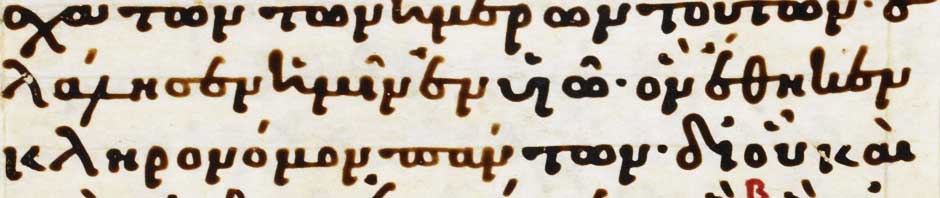
The room is dim, the table low, hands reaching across shared bread. In this moment, every article and case ending leans forward—grammar itself bending under the weight of remembrance.
Καὶ εὐχαριστήσας ἔκλασεν καὶ εἶπεν Λάβετε, φάγετε, Τοῦτό μου ἐστὶν τὸ σῶμα τὸ ὑπὲρ ὑμῶν κλώμενον· τοῦτο ποιεῖτε εἰς τὴν ἐμὴν ἀνάμνησιν (1 Corinthians 11:24)
And having-given-thanks he-broke and he-said, Take, eat, this-NOM/ACC.N.SG of-me is the-NOM.N.SG body the-NOM.N.SG on-behalf-of you-GEN.PL being-broken· this do-IMPERATIVE.PL into the-ACC.F.SG my-ACC.F.SG remembrance.
Τοῦτό … τὸ σῶμα … τὸ κλώμενον
τοῦτο
Green (#2a9d8f) marks article–noun–participle agreement chains; yellow (#e9c46a) marks anaphoric repetition pulling the action forward.
The Story the Endings Tell
Morphology Spotlight
1. Τοῦτο — NOM/ACC.SG.N of οὗτος (“this”)
| Case | Masculine | Feminine | Neuter |
|---|---|---|---|
| Nom | οὗτος | αὕτη | τοῦτο |
| Gen | τούτου | ταύτης | τούτου |
| Dat | τούτῳ | ταύτῃ | τούτῳ |
| Acc | τοῦτον | ταύτην | τοῦτο |
The neuter form hovers between nominative and accusative: is it subject or object? The ambiguity draws attention—this is not just bread; this is proclamation.
2. τὸ σῶμα — NOM/ACC.SG.N of σῶμα (“body”)
| Case | Singular | Plural |
|---|---|---|
| Nom | σῶμα | σώματα |
| Gen | σώματος | σωμάτων |
| Dat | σώματι | σώμασιν |
| Acc | σῶμα | σώματα |
The neuter nominative stands as the identity claim: the bread is declared, grammatically and theologically, as “body.”
3. κλώμενον — NOM/ACC.SG.N pres.mid/pass.part of κλάω (“being broken”)
| Case | Masculine | Feminine | Neuter |
|---|---|---|---|
| Nom | κλώμενος | κλωμένη | κλώμενον |
| Gen | κλωμένου | κλωμένης | κλωμένου |
| Dat | κλωμένῳ | κλωμένῃ | κλωμένῳ |
| Acc | κλώμενον | κλωμένην | κλώμενον |
The participle agrees perfectly with τὸ σῶμα: the body is not static—it is actively “being broken,” a present, unfolding reality.
4. ἀνάμνησιν — ACC.SG.F of ἀνάμνησις (“remembrance”)
| Case | Singular | Plural |
|---|---|---|
| Nom | ἀνάμνησις | ἀναμνήσεις |
| Gen | ἀναμνήσεως | ἀναμνήσεων |
| Dat | ἀναμνήσει | ἀναμνήσεσι |
| Acc | ἀνάμνησιν | ἀναμνήσεις |
The accusative signals direction: the action of “doing” moves toward remembrance—not mental recall alone, but covenantal re-presentation.
If ἀνάμνησιν were dative instead of accusative, what nuance would shift?
The sense of intentional movement toward remembrance would soften into mere location or sphere.
Syntax Cubes
[Τοῦτο] — subject
   [μου] — possessive genitive
      [ἐστὶν]
         [τὸ σῶμα]
            [τὸ κλώμενον] — attributive participle
               [ὑπὲρ ὑμῶν] — substitution/benefit
Semantic Force
The neuter agreement binds everything together: “this… body… being broken.” The grammar refuses fragmentation—identity, action, and purpose remain inseparable.
When Agreement Preaches
Article–Noun–Participle Choreography
The chain τὸ σῶμα τὸ κλώμενον locks identity and sacrifice together. The repeated article signals: this is not an added detail—it defines the body itself.
Anaphoric Echo
τοῦτο reappears, pulling the past act into present practice. The command “do this” carries the same demonstrative force as “this is.”
If Paul had omitted the second τοῦτο, what would fade?
The tight link between declaration and command would loosen.
What If the Paradigm Bent?
Comparative Hypothetical
If τὸ σῶμα were genitive (τοῦ σώματος), the phrase would shift toward possession rather than identification. The Eucharistic declaration would lose its immediacy: instead of “this is the body,” it would suggest something belonging to the body.
Because the nominative declares presence, not distance.
The Table That Speaks Again
You lift the bread, just as they did. The words echo, unchanged, carried not only by memory but by grammar itself. “This is…”—not was, not will be. And as you break it, the participle still lives: being broken. The language refuses to let the moment slip into the past. It pulls you in, gently but firmly, until you realize—you are not remembering something distant. You are standing inside it.