
John 5:6
Τοῦτον ἰδὼν ὁ Ἰησοῦς κατακείμενον, καὶ γνοὺς ὅτι πολὺν ἤδη χρόνον ἔχει, λέγει αὐτῷ· Θέλεις ὑγιὴς γενέσθαι;
The Question Comes Only After Careful Observation
This verse does not move immediately to the question.
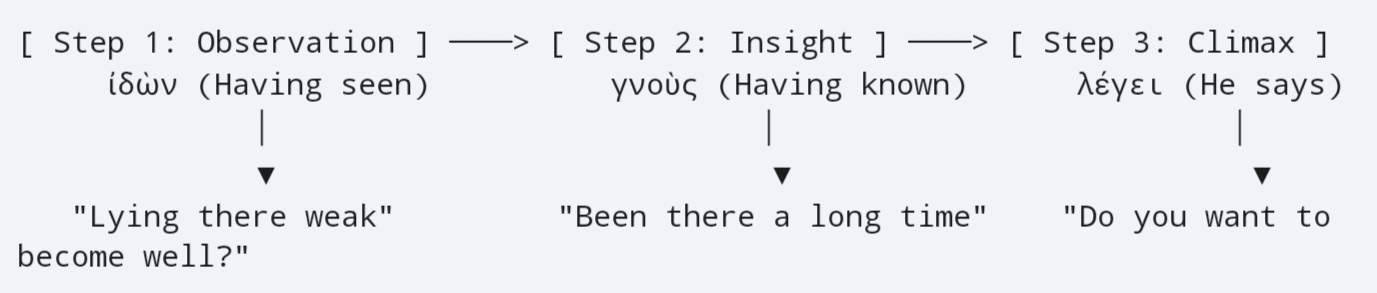
First, Jesus sees the man. Then he understands his condition. Only after that does he speak.
seeing → knowing → speaking
Greek uses participles to slow the scene down and guide the reader step by step toward the final question.
Transliteration
touton idōn ho Iēsous katakeimenon, kai gnous hoti polyn ēdē chronon echei, legei autō; Theleis hygiēs genesthai?
Literal Translation
“Jesus, seeing this man lying there, and knowing that he had already been there a long time, says to him, ‘Do you want to become well?’”
Grammar Focus — Participles Prepare the Main Action
Before the main verb λέγει (“he says”), Greek uses two participles:
ἰδὼν
“having seen”
γνοὺς
“having known”
or “understanding”
Greek often uses participles before the main verb to describe actions or awareness that happen first.
ἰδὼν … γνοὺς … λέγει
“having seen … having known … he says”
The grammar carefully prepares the emotional weight of the question that follows.
Vocabulary Builder — Healing and Human Condition
| Greek Word | Pronunciation | Meaning | Beginner Insight |
|---|---|---|---|
| κατακείμενον | katakeimenon | lying down | Describes someone lying or resting in a weakened condition. |
| χρόνον | chronon | time | Related to duration or passing time. |
| ὑγιὴς | hygiēs | healthy / well | The source of English words related to hygiene. |
| γενέσθαι | genesthai | to become | Greek focuses on entering a new condition or state. |
The Question Is About Becoming
Jesus does not simply ask:
“Do you want health?”
Instead Greek says:
ὑγιὴς γενέσθαι
Literally:
“to become healthy”
The infinitive γενέσθαι emphasizes transformation into a new state.
How the Sentence Builds Emotional Weight
The verse delays the question intentionally.
Greek first shows:
Jesus sees the man
Jesus understands the long suffering
Jesus finally speaks
The structure creates compassion before the question ever arrives.
Greek pacing often shapes emotional tone this way.
Beginner Practice Activity
Match the Greek word with its meaning.
| Greek | Your Match |
|---|---|
| ὑγιὴς | A. to become |
| γενέσθαι | B. healthy |
| χρόνον | C. time |
Small Grammar Challenge: Which two participles prepare the reader before Jesus speaks?
Listening to the Careful Pace of the Greek
This verse teaches beginners that Greek narrative often slows down important moments through participles and sequencing.
The participles ἰδὼν and γνοὺς create thoughtful preparation before the main question appears. The infinitive γενέσθαι emphasizes transformation into a new condition. And the gradual pacing allows the reader to feel the emotional weight of the encounter before the healing even begins.
As readers continue learning Greek, they begin noticing how sentence structure itself can create compassion, tension, and emotional depth.

